The Unipol Group founded the Reputational & Emerging Risk (R&ER) Observatory as an instrument for protecting the group’s reputation and strategy. The R&ER Observatory contributes to the creation and strengthening of Unipol’s reputational assets and strategic positioning over time, generating a competitive advantage and anticipating future trends in order to prevent emerging risks and seize new business opportunities.
Anticipating change is essential to prepare the Unipol Group today for the risks and opportunities of tomorrow. In fact, it is more and more important to anticipate changes because the speed of change has increased significantly; and important to adopt an integrated view as changes are increasingly interconnected.
The creation of the Reputational & Emerging Risk (R&ER) Observatory in 2014 was part of Unipol’s objective to adopt a strategic and proactive approach to the management of reputational and emerging risks. The organisation wanted to take more of holistic approach that considered not just the risks, but also the opportunities.
This holistic approach aims to protect Unipol’s reputation and strategy, while at the same time, contributing to the creation and strengthening of reputational assets and strategic positioning; generating a competitive advantage and anticipating future trends so as to seize new business opportunities.
The value brought to the Unipol Group by the R&ER Observatory is the guarantee of a window on the future, that is openness to signs of change in the various dimensions of the external context – i.e. social, technological, environmental, and political aspects – as well as the competitive environment, providing a 360-degree overview of emerging trends in order to ensure adequate protection from related threats and, at the same time, seize new opportunities in advance and guarantee an effective safeguard of emerging reputational risks by ensuring a continuous alignment of the Unipol Group’s responses to the stakeholders’ expectations.
The strategic value for a predictive model
The objective of the R&ER Observatory is to promote “integrated thinking”. This is achieved through both the interpretation of the external environment by analysing not only technological but also social, environmental and political changes and their interconnections; and in the analysis of the company’s internal response that encompasses the various business areas and phases of the value chain.
The strategic value of this approach provides a systemic and structured approach to integrate the various external perspectives. Unipol has an overview of the external context allowing it to rapidly identify any signs of change. It also brings these trends closer the business of the insurance sector by specifying the impacts for each phase of the value chain and each functional area.
The R&ER Observatory is proposed as a tool for reflection and a stimulus for the various departments at Unipol in identifying and preparing for the challenges of the external environment during strategic planning and subsequent monitoring. This allows it to provide responses in line with stakeholder needs and to develop and promote resilience.
It also helps Unipol to consolidate its prominent position on an international scale and in its commitment to play a leading role by anticipating and guiding the upcoming developments of future society.
Published March 2021
The methodological framework
A focus on risk management underpins the philosophy of the R&ER Observatory in its holistic approach to risks and opportunities.
The keystone of the R&ER Observatory is its “Internal-External Alignment”. The internal perspective is integrated with the external perspective in order to ensure constant alignment between stakeholder expectations and Unipol’s responses today (for reputational risks) and tomorrow (for emerging risk).
Materiality is the concept used to filter topics: over time, Unipol’s response is aligned with stakeholder expectations regarding currently material issues and expected material issues in the next five years.
The R&ER Observatory uses a predictive model to identify the issues of the future before they happen. Through structured listening of various sources and the use of mature and tested algorithms, it is able to generate quantitative and qualitative trends relating to its “Tree60” - a “tree” consisting of 360 topics to offer a 360-degree overview of the insurance sector and surrounding external environment.
A structured process was defined for the management of emerging risks intended to: identify the most material emerging trends and their related risks and opportunities; assess the extent of Unipol’s strategic control; define mitigation plans; and carry out constant monitoring and updating.
The R&ER Observatory serves as an outer layer of Unipol’s reputational risk management framework. It provides a reference point that makes it possible to contemplate material impact(s) in a broader context, as well as anticipating social, cultural, technological, environmental, and political changes destined to influence stakeholder expectations.
The R&ER Observatory is founded on four key pillars:
-
Establishment of a technical board
Its composition guarantees multi-disciplinarity from various corporate functions to ensure an integrated and synergetic approach and to overcome potential organisational barriers.
-
Involvement of business managers
Business managers are systematically involved in line with the objective of creating a strategic tool to support organisation-wide development.
-
Use of a predictive model
The Observatory makes use of a consolidated predictive model based on the Meeting Point methodology, developed by sociology professor Egeria Di Nallo. The adoption of a predictive model that is based on a “telescope” - and not the “rear-view mirror” - is essential for the adoption of a forward-looking approach to anticipate future risks and opportunities. To obtain an even longer-term view, it also uses methods based on futures studies for the purpose of building future scenarios in the long term.
-
Integration of the stakeholder perspective
The stakeholder (external) perspective is integrated in the risk management system in order to enrich the internal vision of management.
The Emerging Trend Radar
The R&ER Observatory fuels the Unipol Group’s Emerging Trend Radar (see below), which maps the most material emerging trends for the organisation and that should be kept under observation and monitored.
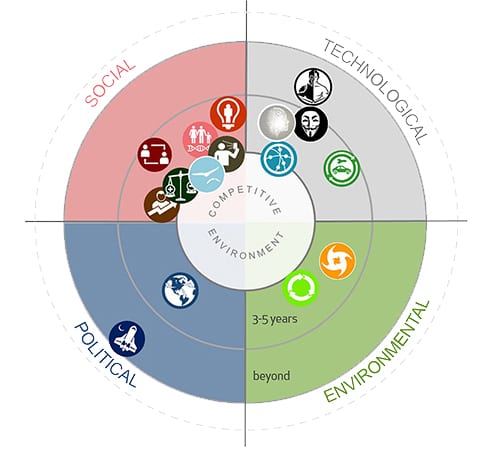
In the context of the Emerging Trend Radar, each topic is classified based on:
- its prevailing nature: the radar is divided into four quadrants that correspond to the four dimensions of the external environment: social, technological, environmental and political (STEP);
- and level of maturity: in the innermost circle the radar includes the emerging themes that are material for the insurance sector within the next five years; and in the outer circle the emerging themes that will become material after five years.
The R&ER Observatory aims to monitor the evolution of the emerging macro trends identified as well as the early signs of any new topics “to watch” and new macro trend to be included in the Radar.
There are 16 emerging macro trends for the insurance sector. Initially (in 2015) the top 10 emerging macro trends were identified, in terms of their impact on the insurance sector and the Unipol Group in a five-year horizon. Between 2015 and 2020, six additional trends were added.
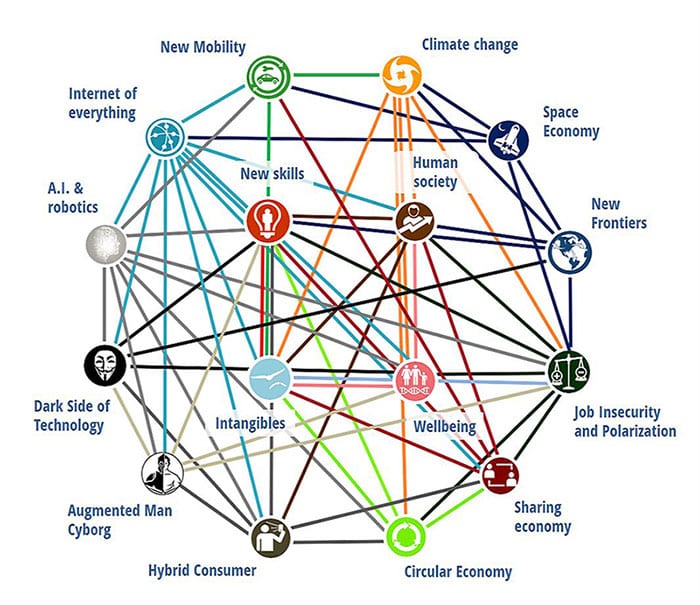
The Interconnection Map (see below) provides a systemic view, highlighting how the macro-trends are connected to each other and may generate driving trends causing a potential domino effect.