Liz Green:
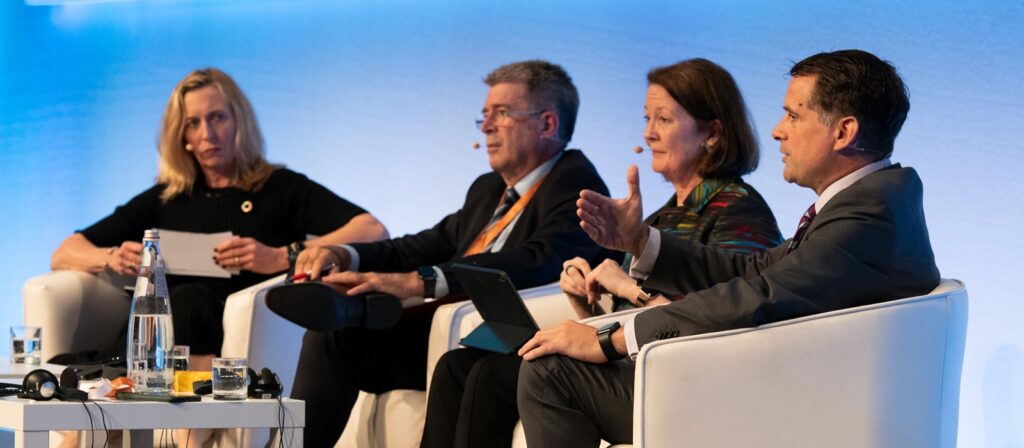
Welcome to our fifth in this series of our quarterly ICMF webinar, all about leadership and leading with purpose with a panel of CEOs and executive leaders from different continents. This particular session is going to focus on a number of areas, which will include leveraging mutuality, we’re going to look at the leadership challenges from around the world, and boy has the world changed, so I’m sure there’s lots to discuss there. And then we’re also going to look at how businesses are adapting to all this change in the future while still maintaining our focus on being purpose-led mutual leaders. I have an extremely illustrious panel with me today. I’ll introduce you one by one. We have Jan Kamp Justesen who is our CEO of LB in Denmark. Welcome Jan.
Jan Kamp Justesen:
Thank you.
Liz Green:
We have Jim Islam who is OneFamily’s CEO in the UK. Welcome Jim.
Jim Islam:
Thanks, Liz.
Liz Green:
And then we have Steve Linkous, who is president and CEO of Harford Mutual in the US. Nice to meet you again. Lovely to have you here, Steve.
Steve Linkous:
Thank you.
Liz Green:
Lovely. So before we start, I just thought we’d start maybe with Jan and just do some basic introductions so that everybody on this call can hear about your organisation and your affinity groups. Over to you, Jan.
Jan Kamp Justesen:
Thank you, Liz. Yes, I’m representing the company LB Insurance. We were founded back in 1880 where a lot of mutual insurance companies were founded, in Europe at least. We were founded by teachers, primary school teachers for teachers at the time. But since then we have developed into more affinity group company where it is still to a large extent anybody who has anything to do with teaching of some kind. There are many in the society, believe it or not, and we are within healthcare as well, represented quite heavily in a number of typically actually public employee functions. And then all academics in principle in Denmark also has an access to our company.
So in some way we try to sort of make it exclusive to be part of this mutual society, but then again, in reality, quite a few can actually come in. We are company number four on the private lines in Denmark. We are mainly private lines. We have very little commercial or anything like this. So we are non-life and we are private lines, P&C. We have around 900 staff in the company, around 450,000 members. And that, as I told you before, approximates to a fourth place in the market where we are a number of a couple of medium-sized mutual companies competing against the three larger commercial guys.
Liz Green:
That’s great. Thank you for that. Welcome Jan. Over to you, Jim.
Jim Islam:
Thanks, Liz. I was actually looking back at the history of OneFamily. I actually had to do some digging recently into the archives because this year we are 50 years old, which actually makes us a very young mutual by British standards. We are a business set up in a small office in 1975 in London. Later on we moved to Brighton. So we are very proud of our Brighton heritage, which gives us the dynamism and vibrancy that you find in the organisation and what we do as well.
When I looked through the original papers, I found the word modern dynamic mutual even then, which is very, very… Well, I was really pleased with that. But that was always the intent that this is going to be a different kind of a mutual always pushing the boundaries. And as a result, if you look at our history, we started off with a product which used to be popular in those days, family bond. It was a savings and investment product. We then became the largest child trust fund provider in the UK. So our heritage very much is in children’s savings. We are the leading provider with a 25% market share. What that means is that one out of four every 18-year-old this year, last few years, next few years is a OneFamily customer. And it really gives us that connection with the younger segment of the population.
But if you look at that history, we have always adapted, we’ve always changed, and that is exactly what we have been doing recently. We’ve gone through a number of mergers and acquisitions as well. We’ve acquired a number of businesses. And present day, yes, we have that strong position with children’s savings. We have one and a half million members, but actually it’s quite a diversified membership now. We are a life insurer as well. We are a multi-brand business. We sell protection business through another brand called Beagle Street, which is a very digital brand. And we are also now offering other investment products in the UK which are more tax efficient. So a diversified life insurer and investment organisation.
Liz Green:
Wonderful. Thank you so much, Jim. And last but definitely not least, hello Steve. Over to you
Steve Linkous:
Will do. Thank you. And good to see you all. So I guess I’m the old guy in the group here today. Harford Mutual Insurance Group was founded in 1842. We have always been in Bel Air, Maryland, which is just about an hour north of Baltimore here on the east coast. I’ve been here at the company for 40 years, so almost just 10 shy of Jim’s company being around. So been quite the journey.
We started as many mutuals did here in America, you know, really providing insurance services to personal farm owners and even businesses back in the days. And when I joined the company 40 years ago, we were predominantly a personal lines insurer. About 60% of our premium came from homeowners and then the rest was commercial. And over the last four decades we’ve really transitioned to a point to where we are now 100% commercial, we don’t have any personal lines anymore. And part of that was really just making sure that we had a differentiator in the marketplace because homeowners and personal lines has become such a commodity type of insurance, we wanted to differentiate ourselves and be able to bring that mutual practise and mutual way, if you will, to the commercial side.
So we write in 13 states from New Jersey all the way down the coast of America to Georgia and then into the Midwest with a few more states. We have about 22,000 policyholders and we write just shy of 500 million US dollars of premium on that front, and we have about 290 employees on there. The company, the group actually has multiple companies. We have Harford Mutual Insurance Company, which is our standard company. We have a debit company called 1842 Insurance, where you could probably figure out where we got that name, First Line Insurance, which is our preferred company. And then in 2023 we merged in a mono-line work comp carrier in Kentucky called ClearPath that added about $52 million of premium, about 60 employees and $85 million of surplus to bolster the company’s capital on that front. So we’ve definitely transitioned over 182 years and looking forward to our future.
Liz Green:
I have to say, Steve, for somebody that’s been there for 40 years, you’re looking good on it.
Steve Linkous:
Oh, thank you.
Liz Green:
It’s obviously been a very, very positive journey for you.
Steve Linkous:
It’s been great, it’s been great, thank you.
Liz Green:
First question for you guys to have a think about. So we’re thinking about obviously this world, there’s lots of challenges. It keeps changing, particularly in the last six months, I think the world’s sort of flipped over. So what’s the biggest challenge for your organisation at the moment and what are you doing to tackle that? And I’ll open that to whoever feels brave and wants to start first.
Jim Islam:
Shall I go first, Liz?
Liz Green:
Yes, please Jim. Go ahead.
Jim Islam:
I think that it’s quite important. It’s not just what’s happened in the six months, but we have been going through a pretty tough time, whether it’s the cost of living crisis, war in Europe, you name it, it’s been very tough for the consumer. And you know, as a customer-led business and listening to our customers, what’s been clear to us that we need to shape our strategy, our products, our proposition in light of those macro changes.
So what we did before development of our strategy, we actually looked at those macro trends and we identified very clear five macro trends. And in fact over the last six months those have worsened in some ways. But if I just pick them up very briefly, first is threadbare safety nets. And what it means is that with the added pressure on government budgets and the need to effectively balance the books, individuals have to take greater ownership for their own financial security needs. But that is what mutuals are doing, when mutuality was invented hundreds of years ago, that was the purpose. So that’s one key trend and then we have to play our part in that.
The second bit, which is actually quite important in particular in the UK context, but also globally is lack of social mobility or social inclusion. Now as an organisation that has always been giving voice to the younger population, what we find in the UK, it’s the young people, they’re finding it very difficult to buy their first home, their social mobility is a huge challenge. So we identified as that one trend again and again, we have to respond to that.
The third bit is working revolution. It’s a combination of what’s happened post-COVID in terms of hybrid ways of working, but more importantly the impact of artificial intelligence and what that means not only for the workforce but also in terms of organisations and how we respond to that. The fourth one is, we call it electric living, but that’s climate change. And again, we have a role to play in terms of responding to that. And the final one is people living longer. We call it the 100-year life. And again, we respond to how do we respond to that.
So those are the five key challenges we identified. Now the reality is we cannot address all of those big five key challenges in one go. And we are pragmatic about that. So we have picked up a couple that we are currently very focused on. One relates to social mobility and inclusion. Because of our position in the younger saver market, we are very keen that we play our part in that. Now as it happens, there is a product in the UK, it’s called Lifetime ISA, which enables younger people to save for their first home. We are playing a very active part in that.
But more importantly, it’s not just about fashioning products but also about giving voice to the voiceless. We’ve always been a campaigning voice in the UK on behalf of our customers. So we’re actually asking the government to make some changes in that product to make it more attractive for the younger people to save. And we’ll continue to do that. So that’s one.
And the second one we have picked in terms of the current challenge we need to address is threadbare safety nets. And we intend to address that through our Beagle Street brand. We have had great success with Beagle Street in the online digital space, but the reality is online digital is only 10% of the protection market in the UK. The rest of the 90% is the intermediary market. And what we are doing this year is taking our product, which is actually considered very modern and responsive, and we are taking it to the entry market. And through those two very key propositions, we are trying to address the challenges that we see currently.
Liz Green:
Fantastic, guys. And so for you guys, for Jan and Steve, does any of those areas, those five macro trends, do they resonate with you?
Jan Kamp Justesen:
I can… Should I try first, Steven? At least we have a number of issues in common, but I would like to perhaps start somewhere else, which I don’t know is a global trend or at least it’s a huge trend in Denmark, and that’s what we call consolidation. We do see a lot of mergers and acquisitions in the marketplace primarily driven by and eager to get economies of scale, at least are very much into the IT investments. And this is a driving force for many of our peers in the marketplace. And where we have to sort of, how we have to address it is of course either to find somebody to buy, to grow, to grow organically or be sold, so to say. And the last one, we don’t like very much, at least not for the moment.
But we can also join forces with other mutual companies in order to get economies of scale into the investments in IT, artificial intelligence, you mentioned that, Jim as well, because what we see is that we can rather quickly become the smaller guy in the competition. And also from, and I’m exaggerating a little bit here, whether you are making an AI solutions for one million members or 500,000 members doesn’t really matter. Price is more or less the same. So there is economies of scale into these kinds of things. So though we’re trying to position ourselves in this one as well. So the digitalization is coming, driven by AI and also all kinds of automation of work streams and so forth. And this is a very interesting area for us.
We do also see a lot of instability in premium increase,. Claims inflation. We have in ’23, ’24 had the most rainy years we’ve ever seen more or less, at least as long as we were measuring it in Denmark and had a lot of claims in that respect as well. This is due to climate change. We also see more claims from NatCat events, so that we are trying to address in our community of insurance organisations and with the public sector so to say.
In Denmark we also see a huge increase in electric cars. And they are more expensive to insure actually, they have so many electric devices around and they’re often accelerating more quickly than ordinary cars. I think these days in Denmark we have 60% of new cars sold that is electric vehicles. So this transition we are following very much as well in our end of the world. And then of course the regulatory environment is killing us and therefore we are very eager to see what Von der Leyen can do from the EU part. But it seems that what they are intending to do is taking a long time. So if we could speed things up and deregulate quicker, that would help us a lot.
Liz Green:
Thank you so much, Jan. How about you, Steve? Does anything resonate from what you’ve heard and how does that fit with your priorities?
Steve Linkous:
Well, you know, all things quiet over here in the US, not much going on at all affecting-
Jan Kamp Justesen:
You have an orange man there, Steven. They’re bugging us a little bit in our end of the world.
Steve Linkous:
Yeah, we won’t bring up Greenland at all. We’ll just leave that to the side here at the moment. No, certainly all the above of what Jim and Jan have talked about. Certainly we have that here in the US and we’re trying to deal with it. Maybe just to take a different little slant so we don’t repeat ourselves here, I think we’re all trying to deal with post-pandemic conditions, whether it’s the norm, whether it’s trending up or down. I think we’re all trying to figure out where it is, but we all know that it’s changed and it’s very different. And for us that, you know, like I said, been here decades, I saw more change in the last five years than I saw of course in my first 35.
But then if we harken back to mutuality and really think about, especially for our company, we’ve been around since 19 years before the Civil War, World War I, World War II, all the other economic calamities that have happened, why are we still here? Well we’re here because we take a long-term view of our business and we’re here for our policyholders as opposed to stockholders. Not that stockholder based companies are bad or invalid in some way, but the approach that we take allows for that longevity and really looking at, hey, let’s make a decision for the long term, not the short term from that standpoint, even if it financially is not the best thing for the company at the moment.
I think when we look at what have we been dealing with and what’s my biggest challenges, what’s the industry in the US’s biggest challenges? Certainly already been mentioned, climate change has certainly brought about a significant amount of claims, post-pandemic inflationary, whether it be true financial economic inflation or social inflation, which is certainly quite rampant and set a new norm. And then the last one I would say is of course legal system abuse, which is very unique in the US, not that it doesn’t exist elsewhere, but the way our legal system is and the minimization of our tort reform really puts us in a very different perspective than other countries.
And then I’ll jump on what Jan talked about is, you know, we have, you, we’re in 13 states, so that means I have 13 regulators. So what I have to do for Maryland is different than Georgia, different than Kentucky. So trying to manage all of that and make sure that we’re of course playing by the rules and doing right by our consumers and customers and agents is quite the challenge on that front. So our market is, you know, we got it to a very profitable space as an industry last year, but that took huge premium increases and changes in terms and conditions that our insurers and agents are trying to figure out and manage into their businesses. And unfortunately costs aren’t getting any lower. So those are really what I would cap to what Jim and Jan’s already talked about.
Liz Green:
Absolutely. Any comments on Steve’s challenges?
Jim Islam:
I think when we look at, we have the advantage of patient capital, absolutely, but one of the things that we almost have a greater responsibility of is to be more commercial. That means we have to be more efficient, we have to deliver more value. So this need for commerciality is so, so critical in this present age, especially when we are dealing with inflation. So investment in technology, absolutely critical. And we are already, so we are using AI, we are using AI in speech analytics, we are using AI for a number of purposes. But the thing is, we have not looked at AI or any technology for that matter from the perspective of oh, this is the nice fancy toy we’ve got to use. We’ve always went back to the purpose.
And that’s how people say, you know, we want to deliver better service, we’re very proud of our customer service standards and customer satisfaction score. How can we deliver even better service? How can we deliver even better value? And if you look at it from that perspective, investment in technology is critical. I mean we have had, as I mentioned earlier, we have had an M&A history and one of the side effects of that history is the number of legacy platforms we ended up with.
So over the last few years, we’ve been undertaking a huge technological transformation programme where we have migrated our one and a half million policyholders to a single platform. There used to be 12 legacy platforms, and you can very well imagine it is slow to make change, it’s inefficient and all different kind of challenges. So I think investment in technology is critical, not only to provide better service, but to be cost-efficient. And I think that’s the bit that probably we need to embrace more, the need for more commerciality within the mutual space.
Steve Linkous:
Yeah, I’d agree with that and certainly, you know, now it’s the norm. 20 years ago, maybe even 30 years ago, technology differentiated you. Now it’s a common element that you must have in your business and digitization just is the next phase of that. Companies that are not advancing in their technology are going to be left behind and they’re going to be burdened with expense or difficulty even competing out there.
AI brings an interesting new dynamic to the whole mix. We’ve kind of gone through a year, year and a half of hype and now we’re all trying to discern the reality within AI. I’m not familiar with all the regulations that are going on outside of the US but I can tell you that it’s a major topic for all of our 50 regulators here because they want to make sure that AI is, one, the utilisation of it is protecting data, and at the same time that it doesn’t introduce some kind of bias in unintended discrimination into the formulas.
So I would say we’ve been a little slow to bring on some of the AI platforms that might raise the eye of a regulator here because they’re not quite sure what’s going. And I would say the other is, is that it’s very difficult to get guarantees on data privacy. So if we find, for example, a claim fraud AI tool, we have to submit our data there and there’s a lot of PII private information in that data. The vendor will provide us some assurances and safeguards, but the backend AI platform, you know, name your Google, ChatGPT, whatever, they’re certainly not going to provide those guarantees and they in fact are going to take your data and utilise it to build their model because that’s how it becomes better.
So I would say on moving forward with AI, that is our biggest challenge right now is really evaluating the whole data security. But certainly agree with Jim, if you’re not moving your company forward with technology, you’re going to be left behind. I’m glad that our legacy system is recently completed and now it can unburden us from that and allow us to go after more innovative, efficiency type frontiers that we’ve kind of been limited in doing over the last maybe say decade.
Jan Kamp Justesen:
Yeah, and I can echo that as well. We’ve been going through a long period of time where we change more or less everything that had anything to do with technology and we are in a good place. We are in a position where we are trying to create, and I hear Jim and Steven you say the same, where we’re trying to find room for even more investments into the utilisation of this modern technology, because that is critical for our competitiveness. And I think that is something that we should always, as mutuals, remind ourselves that if we are not competitive in the present marketplace, then it’s difficult to justify why we’re here. So we need to somehow always have that in focus, even though we also with our concepts and purpose as being mutuals can do a lot of other things, but we need to be competitive and be in the marketplace and we need to be at a technological level which equals our competitors. Otherwise we’ll be lost in translation out there I’m sure, at some point.
Liz Green:
Absolutely. And although we’re all in agreement that AI and technology investment is very important and it’s wonderful to hear that, the commitment from you about wanting to make sure, it just helps the member at the end of the day rather than just make extra money and efficiencies around that, obviously most mutuals and cooperatives are people-first organisations, and so all this change, all this AI and technology being brought in, new systems, it does require a cultural evolution for sure. How are you guys handling that kind of challenge?
Steve Linkous:
I think transparency is your biggest item when it comes to effective change management, with anything, but certainly with technology. So the first thing you want to do, let’s say with AI, and say you’re going and trying to put something in loss control, okay, we’re going to do a project there. Well let’s sit down with the loss control individuals and really spell out, this is what we’re doing. We’re not here to get rid of your job, we’re here to enhance your job. You know, here’s the additional capabilities we’re looking to bring to your area, which will then provide better services faster, more in depth for our consumer.
That transparency, although sometimes, you know, it takes time and slows down, it’s a necessary step to really get the buy-in to make these projects successful. We’re dealing with a very different transition than we did 20, 30 years ago when we all had file departments, data departments, whatever it is that don’t exist anymore. AI isn’t necessarily going to wipe out departments. What we’re really looking here is how do we enhance the employees we have, make them more productive so they can be even better providers of services or information to clients or even internally with their cohorts.
Liz Green:
Absolutely, absolutely. And I know Jim, from your perspective, the cultural change isn’t just about AI and technology. You’ve obviously been looking at your demographic and your target market and aligning. Do share a bit about your work there.
Jim Islam:
Yes, absolutely. As we’ve gone through a huge technological transformation, and I think anybody who has been through a technology project will tell you that the biggest challenge is not technology, the biggest challenge is culture and people. And as part of that investment, we actually invested considerably in talent, internally as well as bringing in new talent. And one of the things we did along with this transformation programme was to launch a new employee value proposition. We have a quite a young workforce and there is an element of, yes, there’s a very strong association with the purpose, but also what is in it for me? How do we help people develop their careers in the organisation? What are the various career paths? How can we sort of make work more interesting? And given a purpose-led organisation, how do we actually enable people to play a bigger part in their societies, in their communities?
So all of this has been part of that new employee value proposition. We actually launched three new values as well, and I’m going to go through that. But one of the values is courageous and words like that, they bring about that sense of urgency, but also the sense of ambition that we have needed in the last few years. And communication is one more thing. And in the post-COVID world, especially in the hybrid setup, I just cannot overemphasise the importance of communication, bringing people along, being authentic.
As someone said, only the truth sounds like the truth and that’s what people want to hear. And I think, when we are open to the people, they get behind you, they can see the why. They understand the why. And as part of that you have to make difficult decisions. We are a fast-growing business, but we have had to take costs out as well. And unfortunately we had to let people go as we have been recruiting people. So all of that requires that authenticity and bringing people along. But one of our strengths as a purpose-led organisation is that people know we are doing it for our communities, for our customers, for the good of the society. And that’s a great strength that we have.
Liz Green:
Yeah, that’s wonderful. That’s the way to deal with, as Steve already said, you need that transparency, keep that transparency, communicate, communicate, communicate. That’s definitely been my background. I’ve done a few bigger M&A pieces and it is very, very challenging to get the right people, feeling the right message and accepting the right message might not be always what they want to hear. How about you, Jan, how about you? How’s cultural transformation going on in LB?
Jan Kamp Justesen:
I was smiling a little bit when I heard Steven and Jim’s comments because we have two values which are very strong and we live with very much and we try to sort of emphasise every day and try to sort of impart into people as much as we can. One was, Steven mentioned, transparency. That’s one of our values. And basically we translate it in many ways, but we also translate it into the fact that everything we do, we have to be transparent about to our members and to our staff as such. So we cannot hide anything, every decision we make, everything we do, we have to be transparent. We have to be open about this to our members so that they can see what we do and they can disagree as well, but we can take an open discussion about it.
And Jim, you mentioned community, which is the second value we have, which is a community among ourselves in the company, among employees where we stress and emphasise and fertilise, you might say, constantly this about being a community where we help each other in getting the most satisfied members in Denmark for within the community.
And it is a community as well with the members because as I often say to new staff coming to or always say to new staff coming here, we are a community with our members. We do not have to sort of serve two lords as a stock market and the client, the client and the stock market is exactly the same with us. So it’s much easier, I usually say, I know it’s difficult, but it is much easier because we only have one client we need to serve and that is the members, you might say. So these two things I think we had in common and that is very strong with us and we also constantly try to emphasise it is not just a project in the drawer, it is something we try to live every day in the company’s history.
Liz Green:
Absolutely, and you’ve all mentioned authenticity and it comes through in buckets as we say in the UK, in terms of how you all speak and your employees who are delivering that service for your brand obviously are getting that message. I know that all three organisations, you’ll win awards. I know that’s not what you do it for, but your employees really recognise the authenticity and the promise that you keep and that’s a wonderful thing. And I do notice that you don’t really shout about it and that’s almost even nicer. It’s kind of there, but it’s not a big deal because that’s just who you are as organisations.
But it’s brilliant to know that you have such an amazing contribution to your communities. But a bit more about the actual mutuality piece. How do you make that into something tangible? Is it the work that you do in the community? Is it something that you work on with your employees or is it something else? What does mutuality really mean in your organisation?
Steve Linkous:
Yeah, I’ll jump on that one. Certainly for us, it permeates all that we do. Now, if you sit down and just get down to the transactional level of providing an insurance policy to a policyholder, is there a big difference in that? No, because it’s covering their eventual losses and our promise that we’re going to be there for them. How we do it and how we go about that transaction is very different in my opinion. So when we talk about it from just say the insured standpoint, the main item we want to look at it is that, hey, we’re here for you in your time of need and when you come to us, you’re our primary interest, not in saving dollars that will ultimately go back to the profitability of someone that owns the company. Our interest is keeping you, the owner, happy and satisfied because our surplus, our future, everything is yours. That’s why we call it the policyholder surplus. So that distinction is very, very different.
When it comes to the agent, and we work with independent agencies, what we want to provide is a stable marketplace. Again, long-term thinking and planning, we don’t want to be jumping in and out of markets or making wild changes that ultimately disturb the stability of an agent and their customer are joint insured on that side. So where can we look at things and say, “Hey, we might not be making money in this area, but we’re not going to pull out, let’s try a few things, let’s make some adjustments, let’s see if it works.” As opposed to some of the other larger nationals that just say, “Yep, we’re cutting that off,” and all of a sudden the agent is scrambling.
I do believe that mutuality shows up the most internally in the company and how we are viewing what we do and our commitment back to the community. So much like Jan and Jim, culture is paramount here at the company and community sits right at the top of that. And why? Because we were created in the community by the community, so we want to make sure that we’re giving back to that community that we came from. But at the same time, our employees need some purpose beyond the transaction of insurance.
Yes, we want to be here to help people in their times of need, but we also want to be able to do something more than just creating policies. So that’s showing our employees, this is a meaningful part of who we are. We want you to give back and we don’t want to identify what you should be doing. So we’re not going to pick five, six community agencies that we go tell you you need to participate in.
We engage with our employees and say, “What’s meaningful to you? What do you want to give your heart or your dollars or your time to?” And we will support that on that front. And what that does is it just builds on the culture. We’re not here for Steve or the owners because guess what? Our owners are our policyholders. We’re not here solely to just do insurance. We’re here to give back to our community and make the places we live even more vibrant and growing on that front. I think that creates a tremendous internal community and ultimately puts people in a position where they want to give back to whomever they’re working with, whether it’s internal or external.
Liz Green:
Wow, that’s so inspirational. How does that resonate with you, Jan and Jim?
Jan Kamp Justesen:
Yeah, I could try and give it a go as well because I think it’s not just one thing, it’s many things and many issues that we do every day. If we start from the very top, we also have a lot of activity within charity and donations where we try to stress that this is donated by a mutual company to people in need or whatever we use for charity. So that’s one place. We have a sort of circular economy view on things. So we try to keep the premiums low, we try to keep the cost low, and then we also try to be reasonable when we have the claims, not just trying to avoid any claims that we could so that people can, or the members can feel that we’re actually in a community together where we’re trying to within reason to find a good solution, so to say.
That works a lot at least because where it’s often in the claim situation that you find or you build the loyalty. And when all of these things, including the investments over time and every year, almost every year creates a surplus, then going forward we actually do give what we call a loyalty rebate. So the most loyal members in the community, they are awarded with a premium discount. It’s actually a check or an amount sent out to them just before Christmas so they can have extra big Christmas presents. But that is also a place where we try to stress the importance of being part of a community that if we are in a position where we can give back premium, we will do so. Mostly we can.
Liz Green:
Wonderful. Over to you, Jim.
Jim Islam:
No, I’ll sort of, I’ll echo all the points made. I mean, mutuality is our superpower in simplistic terms. I think I would highlight three things that we, I mean it’s all ingrained in the culture of the organisation. One I would call listening and listening to our customers is absolutely critical. You would, if you visit our offices in Brighton, you will find in our very various breakouts on some young teenagers sitting there giving us feedback on our website, customer journey and whatnot. And trust me, very, very valuable feedback, better than any marketing agency or brand agency for that matter. So listening is a very important part of what we do. It also reflects our higher customer satisfaction scores and standards as well as a mutual.
The second part I would say giving, and giving is not just about money, but also about time and resources and skills and talent. And we work with a number of charities. For us, financial education, increasing life chances. These are important objectives as a mutual, and we work with a number of charities to enable that. It’s not just in money terms, but also helping out with time, but also sometimes we have helped out with technology because usually technological transformation, many charities find it very difficult, but we can help in terms of that capability.
So that’s absolutely important. The third thing is what I would call campaigning, giving voice to the voiceless and campaigning on behalf of our customers. It’s absolutely core to who we are and what we do. And there’s a particular issue around access to funds for individuals with mental incapacity in the UK. I mean the rules are horrendous and very complex. We have been not only campaigning to change the rules, but actually we have changed our processes. We have taken the risk that we will simplify the process, but we will allow easier access to those individuals. So it’s issues like that that where we have a very active campaigning culture within the organisation.
And finally, to echo the points around the patient capital piece is quite important. As Steve said, when you’re working with intermediaries or agents, the fact that you’re not changing things every quarter, the fact that you are there for the long term, you can think long term. If you’re in a market, you are there through thick and thin, whether interest rates go down to zero or they go up to 10%, you’re still there. I think that is a very tangible strength that mutuals bring. So that converts into commercial advantage as well. I would say.
Liz Green:
Wow, mutuality is your superpower. I think I’d agree with that and certainly listening to the three different summaries of how you see mutuality, I would certainly say put them all together and that’s a pretty strong proposition. Before we wrap up, I would really like to bring us back home. You’re part of a global network and you’ve given your time to share with the global network, which we’re so grateful for. So just maybe from each of you, just one idea about how you use your global network at ICMF. How do we support you and how can you support others?
Steve Linkous:
Sure. I’ll start on that. Certainly. We’ve been a longtime supporter of NAMIC, which is our National Association of Mutual Insurance Companies, and we have great relationships there and share information within that group. I would tell you now that we’re almost going into our second year with ICMF, what I appreciate most is the diversity of thought. When I’m sitting here talking to other folks, even though they’re here in the country and maybe 3,000 miles away, they’re very similar stories. They’re very similar issues that we’re dealing with.
When I get on an ICMF call or go to a session or seminar, it’s a completely different perspective because what you might be dealing with economically, regulatory, social, but it just allows us to think differently and bring that perspective back to some of the decisions we’re making here internally, while still being part of this mutual collective. We all think the same way and we’re here for the same thing, and certainly you heard our passion, as you noted Liz, around mutuality. So I would say that’s the number one thing we appreciate most about ICMF when I compare it to the association.
And then lastly, just all the resources that ICMF has pulled together to help us develop our talent, whether it’s been talent like me that’s been here for four decades or talent that is just entering the door or somewhere in the middle, especially with new leaders that are looking for that diversity of thought and experience to help them in their own career path, which is critically important to succession plans within the company.
Liz Green:
That’s wonderful. Thank you so much, Steve.
Jan Kamp Justesen:
I could echo that very much, Steve, but I think I would also like to emphasise that what we have had very, should we say good experience with this, the fact that the networking when we are together with the other ICMF companies have led us to adjust a number of tangible activities. I took my management team up to Stockholm where we met with Folsom at some point of time. We shared some IT challenges and could sit there and cry a little bit about all of our difficulties in this one.
And I’m also this autumn taking the board and the management team to Holland where we are going to visit Achmea. And these are all, should we say, arrangements made during the ICMF meetings around. And that has helped us a lot and we are getting very much inspired and taking issues with us back home that we can use either to solve things or to get inspired. And I would just to emphasise that again, Steve, you mentioned it, we are on each side of the planet, but we have very much the same challenges and we think very much alike even though we are in very different countries and we can certainly inspire each other and learn from each other. This is our experience so far.
Liz Green:
Wonderful. And Jim, will you take us home?
Jim Islam:
Yeah, absolutely. I think we live in a world of wicked problems and I think what I find the strength within the ICMF network is this open sharing and collaboration. I was there at the ICMF conference in Buenos Aires. I mean it was a celebratory event, a joyous event, but so much being discussed and so much getting… I brought so much back home. But just to give you an example, over the last two weeks I’ve had, again organised by ICMF, two meetings with two CEOs in different continents, North America and Africa. And when you look at what they are doing and what we are doing, there’s so much in common and I’m thinking there’s so much we can learn from each other. And where there are opportunities to collaborate, absolutely, because we are all trying to do right for the societies we serve. So I really enjoy these collaborative moments and I take so much out of them. And long may it continue.
Liz Green:
That’s wonderful. And what a lovely way to finish our discussion today. Long may it continue. I have to say to all three of you, incredible leaders, you’ve been so open and generous with your feedback and with your insights. I hope the rest of our network gets as much out of it as I have today. I hope you’ve enjoyed it. It’s been a really interesting and pleasurable experience, certainly for me. And I just leave you with the thought that this is the fifth of our CEO panels. There will be another one next quarter. And I look forward to speaking to each of you individually as we meet up somewhere in the world in the next few months and thanking you all. Thank you so much for your time. Bye-bye.