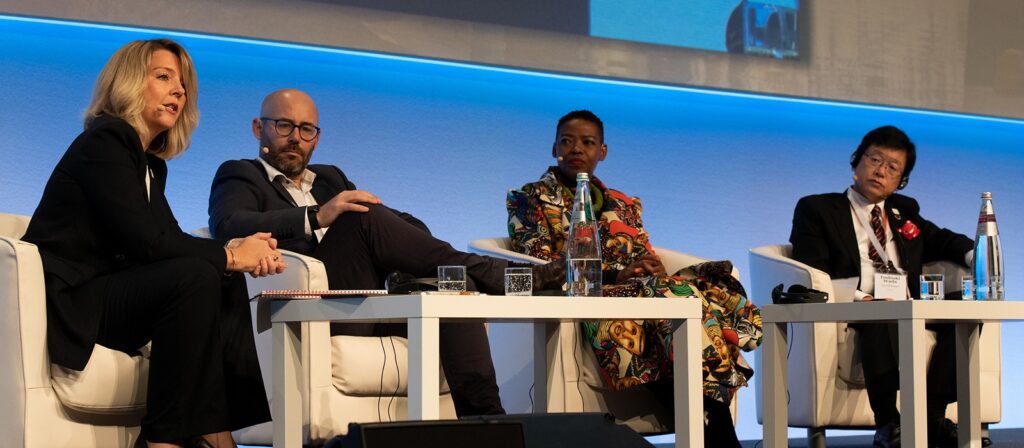
Lana Slygh:
Hello everyone. It is good morning for me. But hello to everyone regardless of what time you guys have. I am Lana Slygh, like Vicky said, and I’ve got the great privilege of representing Thrivent and leading our brand and integrated marketing efforts here.
And so you might be asking yourself, who is Thrivent? All the bullet points on this slide are true about who Thrivent is, and I’ll add a little bit more colour for all of you. Thrivent is a not-for-profit financial services organisation and we believe that money is a tool, not a goal. We put generosity in the heart of saving and investing and we help build, grow, and protect financial wellbeing through purpose-based advice, insurance, investments, banking, and generosity programs.
So while we are all here, we are all in the mutual space for a consumer who isn’t in this space, the Thrivent story is complex, yet beautiful, and we need to find ways to really weave it together and to tell it simply and clearly. And that’s what we’ll talk about—more about how we are re-imagining our brand.
So let’s go back to the way beginnings. Thrivent’s history dates back to 1902 when community members really came together and formed Aid Association for Lutherans. In 1902, we later merged with Lutheran Brotherhood and then ultimately in 2001 became Thrivent, simplifying our name when the two organisations came together. And then up to 2020 was our latest rebrand where we simplified our name to Thrivent and then really introduced this really beautiful logo and word mark that we still use to this day, Thrivent Thrive.
Part of that 2020 rebrand was really simplifying our complex house. So when you think about brand architecture, we had a lot of different names of sublines of business and several of them represented their own logo. So it was really, really important that we introduced one brand standard and one brand guideline, and we brought all of that complex brand house to really be a branded house that all led with Thrivent and had that same consistency of our logo. So that’s really great things that the 2020 rebrand did.
What it didn’t do as well—and that’s why we’re back here talking again about the next evolution of our brand—was it didn’t do as well at leveraging our uniqueness as an organisation. So again, we are a financial services company that puts generosity at the heart of everything we do. And so I would say probably, you know, in more of our beginnings, we looked and acted more like a charity. Then 2020 we really wanted to kind of overcorrect for, uh, maybe showing up as a not-for-profit. And so we really, really leaned into financial services, which was great, but in some of that we lost some of our differentiation and really blended in with, I’d say, the sea of sameness that was financial services in the United States.
So that brings us really to current Thrivent. I would say as an organisation is transforming beyond just our brand refresh. And so we are definitely taking the signals from the organisation of why now was the right time for a refresh in our transformation, and I’ll talk a little bit about that.
So I would say Thrivent’s transformation really started in about 2023. Thrivent recognised that we needed to, first, embrace really the digital future and improve digital client experiences. The second part of our transformation was really about improving our advisor experience. We need to make everything easy for our advisor as they serve the client. So we need to think through both of those lenses: are we attracting advisors to work with us and into our brand and making it easy for them to serve the clients? And what are we doing directly, oh, directly with the clients to make it a great experience?
But the third part of the transformation is really where the rebrand comes in. You know, we have a client base that is primarily white Lutherans in the Midwest and we really do want to evolve. We want a future-proof Thrivent for future generations. And so we want to evolve to be a client base of Christians that is demographically diverse. And so to do that we’re gonna tell Thrivent’s whole story clearly, and that really served as the impetus for a brand refresh.
So where did we start with the brand refresh? We really started by leaning into our values. The values were already set for us or for an organisation. We leaned into our strategic strengths and our strategic strengths, we often also label as our non-negotiables. We can change a lot of things about Thrivent, but those five things need to remain true and core to Thrivent as that is what makes our culture and our organisation so unique. And then we leaned into our purpose.
And so our purpose is a beautiful seven-word statement that does serve as our north star: to empower lives of service and faith. That is our why here at Thrivent. But up until this point—so we’re talking 2024, last year—up until this point, all of the words and the principles on this slide were really internal facing. So it was marketing’s job to say, we really believe this is our, you know, our unique differentiators and what makes Thrivent so special. How would we package this and bring this external so that we can attract more people into our brand? And that’s exactly what we did.
So ultimately, from evaluating what was the brand in 2020 and did it work and what worked well about it, to then really looking at what makes us unique, the next stage in our phase of our rebrand was really diving into client research. So these client insights are really what guided the way to our refresh. And so I’ll walk you through kind of the three pillars here of insights that we found.
The first space was in financial. We’re financial services. So this might seem like a very no-brainer and it was, but the idea here is what we learned through research was that consumers evaluate financial services companies first and foremost based on their ability to meet financial needs. Yes, that doesn’t seem like that is a huge aha, but was really, really good for us to ground us on. So what we’re doing with that insight is really clearly establishing financial credibility. We often say, show us the receipts. So this is where in our advertising and our messaging matrix and frameworks, we need to talk about how many assets under management we have. We need to talk about awards and recognition that we won. We need to talk about, you know, how rating agencies are viewing, you know, our stability. And so first and foremost, if we can’t meet their financial needs, we really lose the opportunity to talk about fraternal or faith, our next two pillars with them.
The next insight is in the space of fraternal. We are a mutual and we are also a fraternal. And so financial services industry in America is pretty low on trust and low on differentiation. And so what we realised here is that our fraternal advantage—the amazing things that we do with and through our clients to benefit and to impact communities—is really, really important and special. And so that is our unique differentiation that we are a financial services company, but this fraternal advantage really helps set us apart from the sea of sameness of other financial services.
And then lastly, faith. If you saw in a prior slide it talked about how we serve Christians. Christians are the core of our membership. And so it is not often intuitive though that finances and faith are put together. Lots of people don’t make that connection, and sometimes if they make that connection, it’s not always appreciated. So what we’re trying to do in our messaging here is be intentional. Words matter. So be intentional with the language we’re using. I would say in prior rebrands and prior messaging, you might see something like Christian values talked about in a piece. So we’re not going to label things Christian values, but we’re going to be really really specific about what do we mean, what are the values we’re talking about? You know, instead of using language like Christian values, so getting very, very specific. So our words can resonate with our target audience.
So the next step on our brand refresh journey—oh, one more thing. So this is just illustrating what that past slide said. So if we lean too far into finances, we’re not differentiated. If we lean too far into generosity, we show up as a not-for-profit. So our secret spot there is right there in the middle that people clearly understand that we are finances plus generosity, and that’s really what makes us unique.
Now the next part of our journey, now that we did these client research and came up with these insights, was to build a brand framework. So there are lots of different types of brand frameworks in, you know, the brand college and the dictionary. This was a very classical brand framework that we used. And so we named it Financial Services with Heart as we believe Thrivent has more heart than any other financial services provider.
And so our brand framework really started with our purpose. We were really, really lucky and really fortunate that we already had our purpose really defined and we really still are living into it and believe it can carry us for the next five, ten years.
So after you define your purpose, the framework would’ve suggested, well, who is your audience? And we need to define our audience. I would even say audience is a pretty broad term. We can get even tighter with that. We can say, who is your design target? So when you think about who are the people that you are building your products, your services, your experiences for, that is who you should put as your design target.
For us, that was a segment of customers that we had already defined and we labelled them our purposeful provider. And so the next part of this framework is really your human truth. So what is it about that purposeful provider that really makes them unique? And for us, our purposeful providers are really, really amazing humans. And for us, we say that purposeful providers live to create a positive financial future for themselves and impact those around them—pretty, again, pretty cool humans. And I want to hang out with those cool humans.
So if that’s our audience and our purpose, and that’s what we know about our audience, oh, why is it doing this? Ultimately we get to what is the brand role. So why is Thrivent here? What is our role to play in helping these purposeful providers? So for Thrivent, we came up with our brand role: to be an impact mobiliser. It says we’re always leading with empathy, optimism, and a service mindset. And we activate unexpected pathways that fuel the aspirations of our clients, their families, and their communities. So that’s awesome.
We now have identified what is Thrivent’s role to play in serving them. And then last but not least, we ended up with our brand pillars, which do coincide with those insights that we found. So we have three brand pillars. First, financial—and in priority order, ’cause we need to do finances, right? Then we layer on our fraternal advantage with, you know, how do we help clients and communities. And then lastly is about faith. And it is about serving Christians that all want to live out their lives generously. So that is our framework, and it all ended up coming together really nicely and what we’re calling a brand platform.
So our brand platform actually is also our company’s new tagline that was introduced just in March. All of this work was just introduced in March, and our new platform and tagline is where money means more. And so we love this. It is so simple and so beautiful, and we love it for so many reasons. We did think it was important that people know we are in the financial services business, that the word money really does resonate, and it is a really approachable word. And then we get this means more. And that is just awesome. Every single client and member gets to decide what means more means to them. But it is about helping, you know, and having your money go beyond yourself. So how does your money make an impact to your families, to your communities, to the causes you care about, which is really awesome.
Once we completed this framework, we really took it to the next phase, which was starting to build a manifesto. And I think about a manifesto and I think about really trying to capture the essence of the brand leveraging words. So I will read this for us all, so you can start to feel the essence of the Thrivent brand.
It says: For some of us personal finances aren’t just personal. They include a lot more people than ourselves: loved ones, neighbours, the communities we call home, and the causes we hold in our hearts. At Thrivent, we help you look at your financial picture with the bigger picture in mind. Our unique combination of financial services and generosity programs unlocks opportunities to make an impact where it matters most. Because even though our business is guiding your finances, our ambition is to make it mean so much more. Thrivent: where money means more.
This really served as the essence of our brand and that really helped kick off the next evolution of the work, which was getting to a design system. You can see in this manifesto that we really did punch up, we help your personal finances, which was really, really great. We also did punch up, you know, how their unique ambition as a purposeful provider, and how Thrivent will help them in it. And so we just ended really well with, you know, a sign-off communication that really evoked the emotional value of kind of the relationship we have with our clients.
Once we felt good with this and we loved this, we moved on to the design evolution. And so we say that our design evolution builds our design system from the heart. And if you haven’t picked up on it yet, the current Thrivent logo does leverage a heart at the end of our T. And so we are leveraging this heart and saying this heart is one of our most distinct visual assets aside from the whole logo. The next thing we have to work with is this heart. And it works so well for us ’cause we talk about we have more heart than anyone else. We believe this is friendly and sincere and can really bring the design system to life. So we’re going to do more things with the heart.
And so as we really started being intentional with using the heart, we also were intentional with looking at the shapes that make up the heart. So here you can see two arch shapes make up that heart. And so they are now core to our new visual system, and I’ll talk more about that. So we’re going to leverage an arch through our design system. And you might be saying, why the arch? We get why you’re using the heart—that’s a part of your logo—but why introduce an arch?
As we looked at why introducing an arch, it is a nod to our faith-based heritage. You know, walk into any basilica, cathedral, or church, you see beautiful arch architecture as well as stained glass windows. It’s a modern design element. Arches are symbols of strength and support. And then lastly, it does serve as a versatile and interesting storytelling tool. So you see our logo, you see the heart, you see this arch element, and now it really all comes together through this mood board.
So this mood board is different pieces of our design system put together to share with you what’s the feeling and the essence of the brand. So you see our existing logo is used here. You see warm colours—we’ve called them the Thrivent Honey and the Thrivent Blue. You see modern fonts, and lots of the headlines really are anchored in the heart as really a punctuation. And you see the arch come to life in all different types. You see it come together through a thin white line that might be overlaid on photos. You see photos inside arches. And then my favourite is leveraging our tagline and wrapping the text as an arch with the heart right in the middle.
This is how our design system really came together. And so our goal is for our brand to become a magnet for people who want to use their finances for something bigger than money. And so let’s talk about how we rolled this out.
All this great work was happening in 2024. We had settled on a March of 2025 launch date, but we knew first that we have a large force of employees and a large field base of financial advisors that directly serve our clients. So it was really, really critical that we got them on board with this brand launch. And so no better way to get them on board with the brand launch than really leveraging our CEO Terry to talk about and to show this brand come to life in this video.
[Video plays]
Thrivent began over a century ago when neighbours came together to support each other. And we have been inspired to serve our clients and communities ever since. But the time has come for us to share what makes us great with the next generation of Thrivent clients, broadening our reach, expanding to more diverse communities, and building on our strengths as our business evolves. Our brand must do the same, telling our story better than before and reaching new people who are inspired by service and faith. And that’s why I am thrilled to share the next chapter in our brand story.
We interrupt this program for a quick commercial break. For some of us, personal finances aren’t just personal. We use money as a tool to help all the people we hold in our hearts: loved ones, neighbours, the communities we call home, and the causes we care about. At Thrivent, we help you plan your financial picture with the bigger picture in mind because the most important thing isn’t what you’re planning for, it’s who. Thrivent: where money means more.
[Video ends]
Our internal launch went amazing, and our employees and our advisors really, really saw themselves in this. And we had people say things like, “I’ve worked here for 20 years and I’ve never been able to really describe who Thrivent was.” And they definitely saw this simple description of Thrivent come to life in a really, really meaningful way.
Once we got through the internal launch, then we started planning for the external launch. And so at Thrivent, we very much use the simple framework of how are we telling our story across paid, earned, owned, and shared media. So really, where our marketing and our ads will show up on TV, on billboards, etc.—like you saw in some of the video—through earned media. So when we secure news coverage and headlines, what are we securing on owned media? So website, press releases, we’ve got a magazine, we do email marketing, all of those great places. And then lastly on shared. So we’ll talk a little bit about what’s next for us in social media. And we’re currently piloting a really cool influencer program. So I will walk through each of these territories.
For paid media specifically, our goal is more brand awareness and consideration. And so we get brand awareness and consideration through reach. To do this, we have invested more in our brand. So we have a $50 million campaign going to really get our word out there for our faith and service segment prospective customers. So we get the word out through really high-profile events like sports in the U.S. and then also through more targeted outlets that might reach a Christian audience.
So to the right, those targeted programs are really, really hitting our target audience, but they have much smaller reach. And on the left side, these are really high-profile sports. They reach and extend well beyond our target audience, but they have huge impact. They drive millions and millions of impressions. So it’s the combination of the two that really helps us spread the word through paid advertising.
Here are some of the results so far. We launched the brand in March. We’re currently sitting here in September. In the first six months of our brand launch, we have seen an increase to our website. Thrivent.com traffic is up 19%. As you guys know as well as anyone if you are sitting and watching TV, the average consumer has their phone in their hand. And so as they’re listening and hearing about Thrivent, they’re also searching. So whether their search drives them to thrivent.com or their search drives them directly to an advisor, we’re also seeing that our advisors’ findability on Google is up to X, which is great. Our goal is to connect with these audiences and ultimately have them meet advisors and take the next step with Thrivent.
Through earned media, we have a fantastic PR team and their job is to position Thrivent as a leader in financial services and in purpose-based advice. And so how do they do that? One of the ways they do that is through developing strategic relationships with reporters really across the country. They help tell Thrivent’s story and they leverage spokespeople around Thrivent. So our CEO, our chief investment officers, all the way through to financial advisors and community leaders. They are actually finding out what are the amazing things happening in our communities and how do we seed those stories to reporters and get more news coverage for Thrivent.
They have seen some really, really great reach and results. They have placed 807 earned media placements this year, which was about an 18% year-over-year growth. And that 807 earned media placements equals 11.5 billion earned media impressions. So really, really exciting to see that we organically are able to tell our story and not only have to rely on paid advertising.
Next, we’re talking about owned. One of the biggest channels in the owned space for us is our website, thrivent.com. The paid media and many of the earned media impressions are landing on our website. And so our website has this cool opportunity to really foster trust with prospects and clients and guide them into the right next action. Sometimes they’re ready to meet with a financial advisor. Sometimes they simply came from a search such as “who is Thrivent” and they’re just looking to explore and get to know our brand more deeply.
We’ve got some great results so far from our website. 35% of individuals have submitted a lead year over year, saying that they’re giving us information about themselves as they want to know more. We see more unique visitors coming to our website year over year. And then we also see our appointment rate—so actually setting up an appointment with a financial advisor—up 19%. So that is all fantastic.
The last piece of the quadrants that we’re talking about is shared. So thinking about shared media is social media and also influencer marketing. This is new for our organisation. We are starting to pilot an influencer program. These are nine of our very first micro-influencers. We have since gone beyond just micro-influencers and test influencers of all different following sizes. But really the goal here is to get our message out through these influencers. These influencers have already built trust with their following, so allowing them to experience the Thrivent brand authentically in their own words introduces Thrivent to their following. This has gotten us really, really great reach and engagement.
I will highlight for you just one of the influencers that we’ve worked with. This is Jalen, and she has about 200,000 followers, kind of labelling her a micro-influencer. We went to Jalen and said, “We want you to position Thrivent as a partner that can help you take control of your finances,” and leverage her own content-making skills. She is a creator to talk about upcoming milestones that are coming in her life and how Thrivent could help partner with them.
Her content creating process was all her own style, her video, and I’ll show you here now and see what she came up with in her authentic way to talk about Thrivent:
[Video plays]
How are we going to buy a house? So I really know how to manage money. I wish my parents taught me more. Is my credit score good enough? What do I do about this? How do I save for this? Is this going to be enough? I’m overthinking everything. Hey girl, did you find a financial advisor yet? If not, I found one. When I first started my career, I was just going with the flow. Now I wasn’t sure how to manage the money I was making, I was just trying to figure out how to make the money. Now that I’m about to get married, it’s no better time than to break these generational curses and really figure out my finances. Thrivent is a financial services company that offers support through its financial advisors on how to manage your money, plan for the future, and set realistic goals. So don’t overthink your money mindset when resources like Thrivent are here to help. Learn more about visiting thrivent.com or reach out for a financial consultation.
[Video ends]
So we love that. That was one of many of the different videos that our influencers are doing. This one obviously happened to lean more into finances, which is good. We gotta do finances right first, but we also have different influencers that are leaning into generosity as well. So we’re excited to continue to explore, explore, and expand on this program.
Here are some early results of influencers. Here is the top line, talking about looking across social, organic, and/or paid overall for Thrivent for a monthly period. And then the bottom line in blue here is talking about the lift that we see when we run influencers. Influencers are getting us about a 60% increase in our reach with clients and prospective clients. It’s getting us about a 52% increase in engagement, so thinking of those people that are liking, commenting, engaging. We’re seeing more relevancy in terms of mentions.
Lastly, we’re seeing Thrivent as a brand—already has incredible sentiment of people who know us do really deeply love us and respect us—but it is seen that it is not harming our brand. It’s actually helping to lift the sentiment of people talking positively about our brand, which are all good things to see. So we will continue to lean into influencers as we mature and scale our program.
So this is just really the framework all coming together. Earned: really equipping spokespeople, making relationships with media. Owned: really thinking about how we leverage our website as a connection. Shared: how do we continue to do cool things in social and test our influencers? And paid: I would say we are investing more. It’s not just investing more, but making sure every dollar is targeted and is working as hard as possible. So that all comes together in how we distribute this really great message.
And then last but not least, no good brand measurement or no good brand strategy takes place without a really, really rigorous measurement plan. So this is how we are looking to track our progress.
If we think about brand health, we really track our progress in brand health through a brand health survey. That survey we run twice annually. So in theory, if we launched the brand in March of 2025 and we’re running the campaign all the way through December in 2026, we will have a survey that will tell us: did we get the lift we were shooting for? We were shooting for a 4% to 7% lift, which is aggressive. Did we get the lift of 4% to 7% in year one? That will ultimately be measured through this brand health survey.
But that’s not the only way we measure. The next element here is campaign effectiveness. Through the campaign, we are making decisions on a weekly basis: how do we optimise that campaign? How does this creative do in this channel with this audience? And so we have multiple—tens and hundreds of pieces of creative. And we are talking about many, many different places distributed across social, across paid, YouTube, programmatic display, out-of-home, TV, etc. And so we’re ultimately trying to figure out what is the best piece of creative on the best channel to the right target audience.
That campaign effectiveness is happening on a weekly and a monthly basis. We’re also leveraging social sentiment that I talked about a little bit, understanding and measuring the impact that our brand is having and people are talking about us on social.
And then last but not least, we have efforts underway to really get to a brand ROI. I’m not sure if any of your organisations use it, but we want to stand up a media mix model that ultimately will help us with attribution. We want to build a strong and healthy brand, and over time we want to see that translate into sales. And so we want to be able to say of our sales force, how many new leads and opportunities are you getting that are driven by marketing? So that’s the beauty of a media mix model and understanding really the true ROI on a media and brand investment like this.