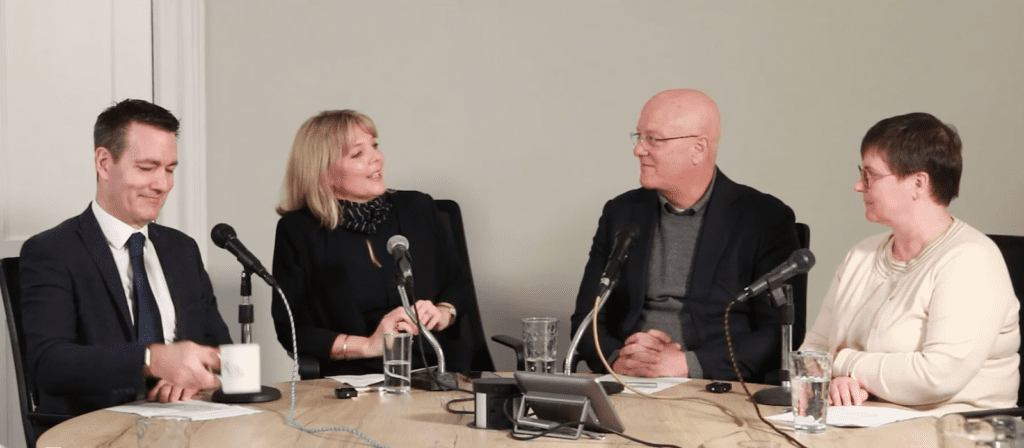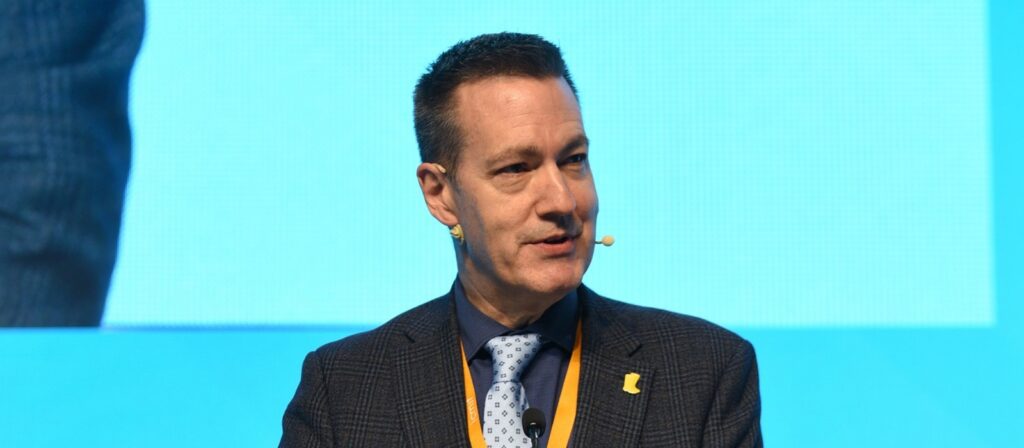
In this CEO interview, Nick Turner, Group Chief Executive Officer of NFU Mutual (UK) is interviewed by Sara Western, HR Strategy Manager & Executive Assistant, NFU Mutual (UK), on behalf of ICMIF. Sara has been involved in many of ICMIF’s Young Leader events and services for a number of years and has, until very recently, also been a member of the ICMIF Young Leader Committee.
In the interview, Nick discusses how the mutual model benefits his organisation, his pride in the excellent customer and member experience that NFU Mutual provides, and how it fosters an award-winning work environment. He also shares his thoughts on the value of ICMIF membership for his organisation and passes on some excellent advice for aspiring leaders at mutual/cooperative insurers.
In a few words Nick, can you tell me about NFU Mutual?
We started in 1910, with seven farmers round a table in a tea shop in the middle of Stratford, trying to get insurance for their hay bales, which was situated next to the London to Stratford (railway) mainline. Back in those days, there were steam engines and the risk of a spark coming from their railway tracks igniting the hay bales was deemed too great and no insurer would touch them. And these farmers decided they would create their own insurance company and then wind that on to today and we are an enormous mutual insurance company still focused heavily on farming, but still with mutual values and a mutual purpose right at our heart.
Thank you. And speaking of mutual purpose, how does our mutual structure benefit us when compared to shareholder-owned insurers?
Well, I think there's two main ways. I mean, the first one is financially and so much as we don't have shareholders to pay a dividend to, we are owned by our members along with all the other mutuals around the world. And that ownership structure is very clarifying in a number of ways. It means that if we make profits, we've got to consider what we do with those profits, with the members in mind. So that's either investing in our business or in fact returning money to them. And we do that through a mechanism called Mutual Bonus. So we're a very strong, well capitalised mutual in the UK, and we're able to return [profits] to members who've been with us for over five years, 10.5 percent off their renewing terms at the moment. So it's a meaningful, tangible benefit. And if we were a proprietary company, we'd be paying that, of course, to shareholders.
The second really important attribute of a mutual, I think, is that we are able to take a long-term view. Many of the proprietary companies have demanding shareholders who want a return on their capital over very short periods of time, and that puts pressure on the management team to think in short-term bursts of value release, if you like. So their dividends are returned in value and the share price moves up. For us, it's much more around investing in such a way that our business will be successful over the long term. And that generates a different flavour of investment that you are likely to make into a business if you're not trying to generate all those short-term returns. And it's ultimately better for members because our members stick with us through thick and thin, there's a real alignment between our long-term investment plans benefiting our long-term members.
As NFU Mutual, we regularly receive awards around our customer experience and member experience. How are we making sure that this continues in the future?
Well, if you want good persistency, customer experience has got to be at the heart of your strategy and it's really simple. If you make life easy for customers and you take great care to make sure they're satisfied and happy with your service, they'll have no reason to leave you. And that virtuous circle is really the power of mutuality and long-term relationships.
So we've now got telemetry across nearly every single customer interaction that we have, both in our agency network, but also at the claims line and when people buy products from us, we know exactly what's going on and whether customers are getting a great service or whether they're experiencing problems. We've managed to create a top 10 hit list of things that we've got to resolve in our business, things that we can do better on, but all of those things have been informed by customer experience. So it's a really vital part of our operating model.
Being a great place to work is one of our long-term strategic objectives. We are very good at it, we're winning quite a few awards at the moment around that, but what do we need to do to continue to foster an environment like that?
Well, you're right, we do win lots of awards and the first thing we need to do is to recognise that the way our people feel working here is important. And it's important not only to attract new people, but also to get the best out of the people that we've got here, so we invest in them. We make sure that they are in a really supportive environment so they can focus totally on giving a great service to our members.
That support mechanism allows them to do great work for us. So it is really important, but the way that we maintain that engagement is through a survey we do every year. We use Gallup, we could have used anybody, Gallop are really good at it but they give us tiny insights into things that we're failing to do to help our staff and people serve our members. And those insights are great. So if they haven't got tools to the job or their laptops don't work, or they're taking 20 minutes to log on in the morning, I want to know about all that stuff because we need to get rid of those things and make sure that they're just able to serve our members in the way that we would wish. And so the engagement survey really gives us insight into what gets in the way of people doing great work.
In respect to ICMIF, what is it that you value the most from our membership?
Well, there's lots of things that ICMIF does to really support our business. Every two years they have a get together of all the [member] CEOs at the Biennial Conference and loads of different people go to it from mutuals around the world. And it's a fantastic opportunity just to sit down and chew the fat with other people who've got similar problems to me and hear how they are tackling them. And there's so much to learn from each other.
One of the really powerful things about ICMIF is it doesn't feel like you are dealing with competitors who are trying to get an edge on you. It's really, look, we've got complexity, you've got complexity. Let's just work through this together. It's a really transparent and straightforward environment because in many cases we aren't competing at all. Mutuals tend to be in country models, there are a few, but they don't tend to be global. There's plenty of mutuals out there that you are really very unlikely to have to compete with, but who have very similar models to your own, so just that is a fantastic starting point.
We’ve also got access to the ICMIF Knowledge Hub where people highlight things that they think they do that's rather good, and what a brilliant opportunity to tap into other areas where organisations are winning. And then on top of that for young leaders like yourself, having an opportunity to engage with other young leaders from mutuals around the world is really helpful as well. It opens up eyes to all sorts of things and possibilities. So those three things are, and there's more by the way, but those three things I would just list at the top.
And finally, as an aspiring leader such as myself, what would be your one piece of advice for me?
Ah, well that does depend what you want to do. And I think that's perhaps part of it is, as a young leader I would encourage you to think about, what are the environments that you thrive in? And to think about how you create more of those environments or become involved in those sort of environments throughout your career. And recognise when you are in a great environment and when you're not, and make sure that that environment is really getting the most out of you. And that does need some design, and I apologise for being vague there, but it is a very personal thing. You have to work out exactly the environment that you thrive in, and then seek it out and make sure that you get the most out of that environment for you.
Click here to find out more about ICMIF's Young Leaders initiatives, or if you have any questions, please contact Georgina Compton.