
ICMIF Supporting Member AM Best provides an overview of some of the latest trends in the cat bond market. ILS market capacity reached USD 120 billion by year-end 2025 with cat bonds and sidecars driving ILS market growth. Meanwhile, ILS market returns are trending down but finished 2025 strong.
Insurance-linked securities (ILS) capacity continues to reach record levels. The ILS market has grown from niche to established with returning sponsors/cedants. Investors’ understanding and confidence in the market has grown. Catastrophe (cat) bond issuance has become routine, as sponsors appreciate another source of capacity, and investors recognise the attractive returns and diversification benefits. The growing market gives investors more opportunities to invest. The market is also expanding with more perils and geographies.
Guy Carpenter and AM Best estimate the ILS market reached USD 120 billion at year-end 2025, up from USD 107 billion at year-end 2024. The 144A property cat bond market reached USD 57 billion outstanding as of year-end 2025; the year-over-year increase from 2024 is nearly USD 12 billion. 144A property cat bonds account for approximately half the capacity of the ILS market.
The capacity for the other ILS segments is estimated to be:
- Collateralised reinsurance: USD 36 billion to USD 40 billion
- Sidecars: USD 16 billion to USD 18 billion
- Industry loss warranties: USD 4 billion to USD 6 billion
- Other cat bonds (cyber/life & health/private natural cat, etc.): USD 3 billion to USD 4 billion

The article is reproduced from a Best’s Special Report with the kind permission of ICMIF Supporting Member AM Best. To access a complimentary copy of the full report, please click here.
Published March 2026
The ILS market is anticipated to grow in 2026, albeit slower than 2025. The earnings from 2025 are projected to flow into new ILS investments in 2026, but investors might take some profits rather than redeploy as the market continues to soften. Cat bonds have been the major drivers of growth in the ILS space, but the high levels of capacity have led to softening rates for cat bonds, which could slow the rate of further deployment into this segment. Diversification benefits and expanded peril coverage will also continue as drivers for capital inflow into the ILS market. As the property cat market softens, ILS fund managers may continue to look at other risks, such as casualty ILS.
Reinsurance demand continues to increase, driven by expanding insured exposures, while the severity and frequency of natural disasters are rising due to climate change. Sponsors appreciate having multiple sources of capital. Traditional reinsurance and the capital markets give sponsors options. Sponsors also appreciate the multi-year capacity provided by the cat bond market.
With the cat bond market softening, investors are exploring ways to attain higher yields. Investors are allocating capital in line with their risk-return objective: some focus on risk-remote layers and accept lower yields in a soft market, while others seek higher returns or broader risk exposures by supporting lower-attachment transactions and private ILS deals, where yield compression has been less pronounced.
Cat Bond Issuance
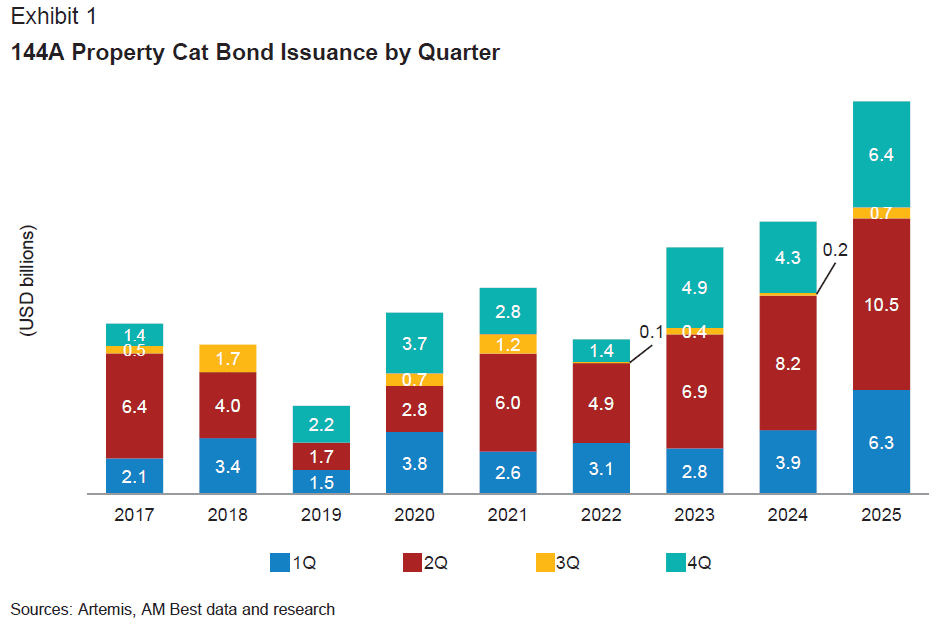
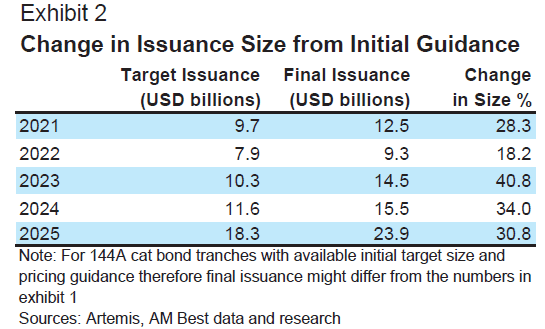
The 144A property cat 2025 issuance volume highlights the market’s growing participation from sponsors and investors. Sponsors tapped the market at a record level in 2025, with new issuance rising nearly 44% year-over-year to USD 23.9 billion. The volume of issuance set a consecutive record in 2025, following 2024’s record of USD 16.6 billion (Exhibit 1). This market expansion was driven primarily by abundant capital supplied by investors along with a broad combination of new and returning cat bond sponsors. These sponsors have become increasingly comfortable accessing the capital markets for reinsurance capacity. The growth in cat bond issuance is reflected by the sharp increase in deal count. Cat bond deals were consistently upsized well above their initial targets, a sign of strong investor appetite. On average, the final issuance size settled at approximately 31% higher than the initial target. (Exhibit 2).
Issuance in 2025 was expected to be elevated partially due to USD 12 billion of outstanding cat bonds maturing, releasing capital that could be redeployed into new issuance during the year. Approximately 67% of sponsors with bonds maturing during the year returned to the market, accounting for approximately USD 16.6 billion of issuance in 2025. The average issuance size exceeded the average size of maturing bonds. Thirteen new sponsors accounted for about USD 1.8 billion of issuance. The remaining USD 5.5 billion of issuance was attributable to returning sponsors who did not have a cat bond maturing in 2025.
Sponsor composition in 2025 highlights a continued shift toward small to mid-sized U.S. domestic insurers, reinforcing a trend from prior years. Participation from this category increased materially between 2024 and 2025, rising from 21.2% to 30.3% of issuance volume, a change largely reflecting the broader expansion of the market during the period. By contrast, the share of issuance among government-affiliated insurers declined, falling from 31.0% in 2024 down to 25.1% in 2025.
Cat bonds have increasingly become a core component of reinsurance programs rather than an opportunistic tool. Cedents employ the multiyear cat bond capacity to secure pricing certainty across different market cycles. In the current market environment, cat bonds often offer more favourable economics than traditional reinsurance in some risk layers, reinforcing their role as a cornerstone of risk transfer strategies. However, cat bonds still predominantly cover the more risk-remote layers of reinsurance towers and play a complementary role with traditional reinsurance.
Notable Deals
Activity in the cat bond market in 2025 was marked by many high-profile transactions that underscored the market’s continued evolution. Beyond an increase in overall issuance, these deals reflected expansion in the type of sponsors, perils, and geographic regions accessing the market. This is an encouraging indicator of the market’s long-term sustainability and growth, demonstrating that diverse insurers can effectively use cat bonds for risk transfer. Investors benefit from a growing and increasingly diversified opportunity set for capital deployment.
Diverse sponsors each placed transactions at or above USD 1.0 billion in 2025. Everest Re, a large Bermuda reinsurer, sponsored USD 1.0 billion in the first half of the year to secure coverage for multi-region named storms and earthquake exposure. State Farm, the large US primary insurer, sponsored USD 1.55 billion for multi-peril indemnity protection. Other notable issuances came from government-affiliated sponsors: USD 1.57 billion from the California Earthquake Authority, a publicly managed and privately funded organisation that provides California residents with earthquake insurance, and USD 1.1 billion from Florida Citizens, the Florida property insurer of last resort.
The California FAIR Plan Association made its debut in the cat bond market by sponsoring Golden Bear Re Ltd. (Series 2026-1) to provide USD 750 million in protection against California wildfire losses. This comes following a historic year of wildfire losses in California. As the largest wildfire cat bond at issuance, it strengthens the FAIR Plan’s reinsurance programme by transferring a substantial portion of wildfire risk to the capital markets.
Cat Bond Loss Multiples
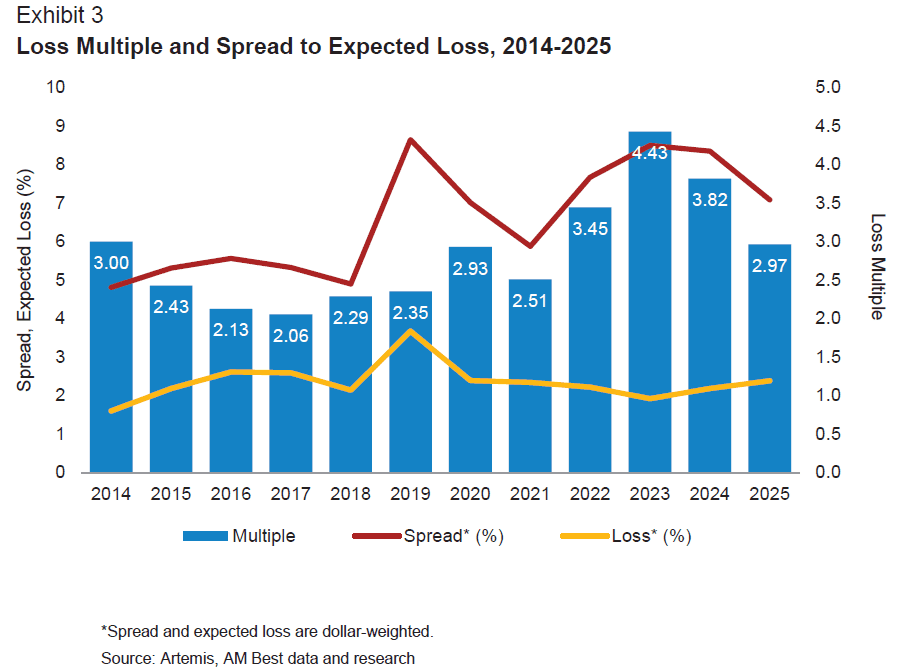
Capital inflow into the 144A property cat bond market continued to outpace demand for capacity, creating excess capacity that compressed spreads. Strong investor appetite, combined with abundant capital from maturities during 2025, exerted meaningful downward pressure on pricing. Weighted average spread declined to 7.08% in 2025 from 8.35% in 2024, reflecting competitive capital conditions. Spread compression makes cat bond pricing more attractive to cedants relative to traditional reinsurance, supporting continued engagement from sponsors. The weighted average loss multiple for 144A cat bonds in 2025 was 2.97, down from 3.82 in 2024 and 4.43 in 2023, but still higher when compared to other years in the past decade (Exhibit 3).
As observed in 2023 and 2024, there was pronounced seasonality in the average loss multiple, with materially different levels between the first and second half of the year. The weighted average loss multiple in the second half of 2025 was 2.40, down from the level of 3.28 in the first half of 2025. Looking ahead, it is likely that the loss multiple in the first half of 2026 will see a year-over-year decline and fall below 3.28, driven by the robust level of capital in the market. However, it is also likely to rise above 2.40 due to seasonal dynamics.
January 2026 Renewals
The 1 January 2026, reinsurance renewals were the most favourable to cedents in the last three years. Softening prices were a signature feature of this renewal, but there were fewer instances of softening in terms and conditions. This conforms to what had been widely predicted: that capacity providers would be more willing to give back some gains in pricing, while terms and conditions would be stickier. The common narrative from reinsurers and ILS managers is that the market is softening but still presents attractive opportunities.
Since the onset of the hard market began with the January 1, 2023, renewals, cedents have achieved substantial rate increases on their primary books of business, making them more comfortable retaining business. Cedents have also become accustomed to higher retention levels and lack of aggregate coverage in the past few years. Overall, demand for reinsurance capacity continues to grow. But cedents’ comfort in retaining business priced at more robust levels keeps the growth in demand muted compared to the growth in supply of capacity.
In addition to rate decreases, another sign that points to further softening is reinsurers’ increased willingness to provide quotes for aggregate coverage. In prior renewals, cedents struggled to obtain aggregate coverage, and sometimes capacity providers were not willing to provide a quote. However, at this renewal, reinsurers were more willing to quote aggregate coverage. Although they were willing to give the quote, the premiums were sometimes higher than cedents were willing to pay, so not all deals were placed.
Natural Cat Losses
The share of 2025 natural catastrophe insured losses borne by reinsurance and ILS was manageable. Swiss Re estimates total global natural catastrophe insured losses in 2025 at USD 107 billion, down from USD 141 billion in 2024. In 2025, the year began with challenges due to the Los Angeles wildfires. However, the absence of a US hurricane landfall resulted in total natural catastrophe losses that remained manageable for reinsurance capacity providers. Guy Carpenter noted that reinsurers’ share of catastrophe losses was approximately 12% in the period 2023 to 2025, down from approximately 20% between 2017 and 2022, which reflects the benefits that reinsurers have reaped from higher attachment points in recent years and the significance of attachment points holding firm at the January renewals.
The cat bond market also emerged from 2025 relatively unscathed. However, the losses sustained by the IBRD CAR Jamaica 2024 loss from Hurricane Melissa and the Randolph Re (Series 2024-1) loss from the LA wildfires were notable. Most of the other cat bonds that have been flagged for loss potential in the past couple of years have been aggregate bonds that have been exposed to various combinations of loss events ranging from Hurricanes Milton and Helene, the LA wildfires, and various severe weather events. This underscores some of the wariness that capacity providers had felt toward providing aggregate coverage.
ILS Market Returns
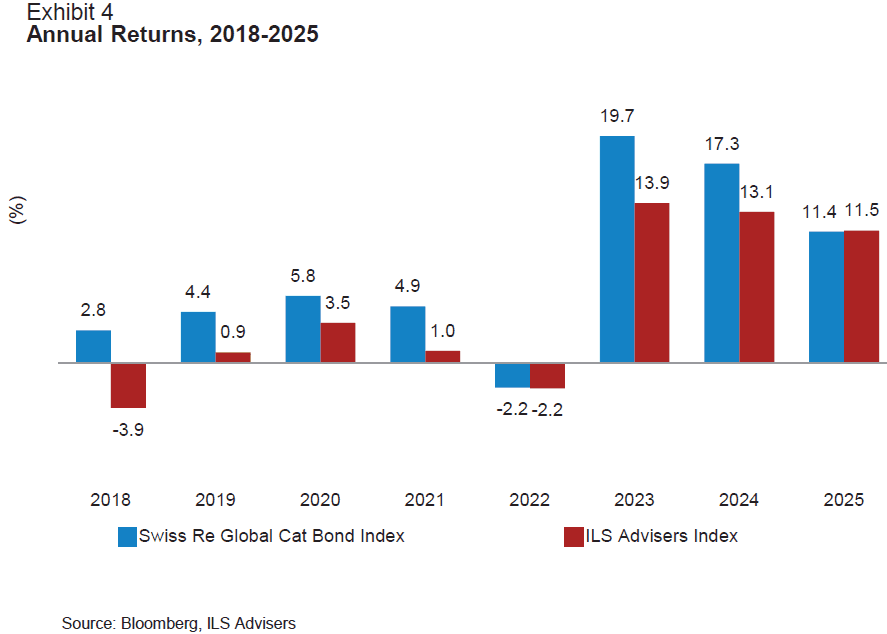
ILS market returns declined noticeably in 2025 compared to 2024. The Swiss Re Global Cat Bond Index return dropped from 17.3% in 2024 to 11.4% in 2025. The ILS Advisers Index return dropped from 13.1% in 2024 to 11.5% in 2025 (reported as of February 12, 2026) (Exhibit 4).
The ILS Advisers Index 2025 return was the third highest in its history. The 2025 Swiss Re Global Cat Bond Index return was also high compared to its historical average.
The Swiss Re Global Cat Bond Index posted a 0.9% loss in January 2025 because of the LA wildfires. Expected losses for cat bonds didn’t materialise as estimated, and therefore losses from early 2025 were offset by gains as the year progressed.
At the beginning of the year, the expected 2025 return for the 144A property cat bond market was nearly 10%, based on average spread, collateral yield, and expected loss. The actual return of 11.4% reflects actual losses falling below expectations, specifically because of a lack of a major US hurricane landfall. Elevated spread levels also contributed to the return.
The 144A property cat bond market began 2026 on solid footing with a weighted average spread of 7.6% on deals in-force as of 1 January 2026, which was down from 7.8% for the cohort of deals in-force as of 1 January 2025. Existing multi-year deals with higher spreads are continuing to run off in 2026. As a result, the average spread on in-force cat bonds will continue to decline. The decline in average spread level will lead to lower returns for the cat bond market, all else equal.
Parametrics
Coverages with parametric triggers were thrust into the spotlight later in 2025 because the IBRD Jamaica cat bond suffered a full loss of principal (USD 150 million) due to Hurricane Melissa in October. Despite the loss, cat bond investors can find solace that the trigger allowed for quick loss determination, rather than waiting for the loss adjustment process as in the case of an indemnity bond. The payout to the Jamaican government also builds credibility for the parametric trigger and cat bonds in general. It reminds sponsors that cat bonds pay out to help to justify the premium expense. If sponsors believe that they are getting value from cat bonds, they will bring more risk to the market, ultimately providing a broader market for investment.
Closing the global protection gap between natural catastrophe economic and insured losses remains an area ripe for innovation for the reinsurance and ILS markets. The World Bank estimated the physical damage to Jamaica from Hurricane Melissa was USD 8.8 billion, which is 41% of its 2024 GDP. This reflects the degree of vulnerability that some smaller and developing countries face from catastrophic events. Following the impact of Hurricane Melissa, the Caribbean Catastrophe Risk Insurance Facility (CCRIF) paid the government of Jamaica a total of USD 91.9 million under both its excess rainfall and tropical cyclone policies. The combined payouts from the IBRD cat bond and CCRIF are helpful but modest compared to the overall impact of the event, so opportunities for further innovation remain open.
With innovation in mind, further strides were made in 2025 to create new coverages with parametric triggers. The Southeast Asia Disaster Risk Insurance Facility (SEADRIF) entered a new type of parametric reinsurance arrangement with the government of Laos, or the Lao People’s Democratic Republic. Specifically, the innovation is the new trigger, which is based on the annual aggregate number of people affected by disasters as reported through the government’s established agency, the National Disaster Management Office (NDMO). This contrasts with other parametric triggers that use a physical attribute like barometric pressure or wind speed.
Parametric cat bond issuance volume was down in 2025. A contributing factor to the lower volume was the absence of a World Bank IBRD issuance. The World Bank has been a major facilitator, issuing parametric cat bonds to insure cat-exposed governments in the developing world.
Primary insurers still overwhelmingly prefer indemnity coverage. To some, parametric coverage is viewed as a hard market product. When the property cat reinsurance market was harder in 2023 and 2024, parametric was used to plug holes in reinsurance towers where indemnity was unavailable or too costly. But even as the reinsurance market softens, there is still a role for parametric in plugging holes in deductible layers because attachment points have been slower to soften compared to rates.
Cyber
Capacity in the nascent 144A cyber cat bond segment grew to USD 1.235 billion at year-end 2025, from USD 785 million at year-end 2024, as Beazley and Chubb returned to the market with additional issuances. Beazley’s PoleStar Re Ltd. (Series 2026-1) is the largest issuance to date at USD 300 million, divided across three tranches. The latest issuance by Chubb, the USD 150 million East Lane Re VII Ltd. (Series 2026-1), has the distinction of being the first aggregate 144A cyber cat bond.
For both the Beazley and Chubb issuances, the loss multiples have declined since their last issuances. The loss multiples across the three tranches of Beazley’s most recent issuance range from 5.1 to 8.5, which is down from the two tranches issued in 2024, which had loss multiples ranging from 10.5 to 11.3. Similarly, the loss multiple on Chubb’s most recent issuance was 5.4, down from 6.7 in 2024; although, the two issuances are slightly less comparable given that the more recent issuance provides coverage on an aggregate basis. All else equal, one might have expected the aggregate coverage to carry a higher loss multiple.
Based on the reduction in loss multiples, there may be evidence of a reduction in the novelty premium that was ascribed to earlier issuances, but it is not clear that such a novelty premium has completely gone away. The 144A cyber cat bond loss multiples are still notably higher than the 2025 weighted average loss multiple of 2.97 in the property cat bond market. The reduction in loss multiple might be less attributable to the absence of a novelty premium and more attributable to the efforts undertaken by these sponsors to educate investors about their books of cyber insurance business and their transparency with respect to modelling, pricing, and exposure management. New sponsors to the cyber cat bond market could potentially see different outcomes.
Abundant capacity in the primary and reinsurance markets, along with muted demand for coverage, suggests that cyber-ILS growth will be modest for now. Cyber insurance has low uptake, partly because it is not mandatory coverage and likely also because insureds may not have a full understanding of their exposure to cyber risk. However, pioneers are enthusiastic about the long-term potential for cyber-ILS and seem inclined to nurture this market in its infancy.
Sidecars
The sidecar segment of the ILS market expanded materially in the past couple of years. The sidecar market is USD 16 billion to USD 18 billion in size, up from USD 5 billion to USD 7 billion in 2023, with most of the growth coming from property catastrophe coverage. There are a few core reasons for the growth in property catastrophe sidecars. Investors have had a strong appetite for the proportional quota-share risk exposure offered by sidecars. Stronger underlying premium rates and improved underwriting margins have been key drivers of investor appetite. Cedents value the sidecar capacity as part of their overall capital management approach. However, the robust growth in the property cat sidecar market is likely to taper off in the near term as the market softens and underwriting margins tighten, dampening the appeal to investors.
Aside from property catastrophe risk, sidecars meaningfully expanded into casualty risk exposure. Casualty lines have remained under heightened scrutiny across the reinsurance segment following adverse loss development and ongoing concerns around social inflation, litigation trends, and a changing legal environment. Despite these challenges, certain capital market participants continue to view casualty risk as attractive, drawn by the appeal of insurance float and the opportunity to deploy capacity through ILS structures. In response, the casualty ILS segment has introduced innovative solutions, notably casualty sidecars. Casualty sidecars are designed to capitalise on current market conditions characterised by stronger insurance pricing, higher interest rates, and wider risk spreads relative to private credit. The long tail duration and risk-sharing structure of casualty sidecars offer investors an opportunity to achieve diversified return profiles while also enabling reinsurers to expand capacity on favourable cession terms alongside traditional market coverage.
Activity in this area experienced the launch of new sidecars in 2025.
- Ascot Group and Antares Capital launched a Bermuda-based collateralised reinsurance sidecar named Wayfare Re. The sidecar amounted to USD 500 million and was capitalised by both companies.
- Ryan Specialty launched a Ryan Alternative Capital Re, Ltd. along with Axis Capital, raising approximately USD 400 million to fund this structure with support from Flexpoint Ford, LLC and Sixth Street.
- Enstar Group launched Scaur Hill Re with USD 300 million.
- QBE Insurance Group Ltd. launched a USD 550 million sidecar, George Street Re Ltd.