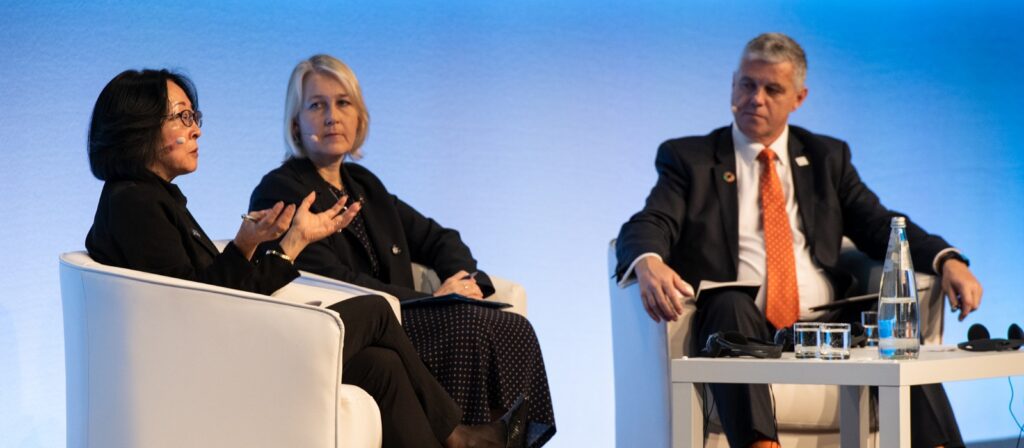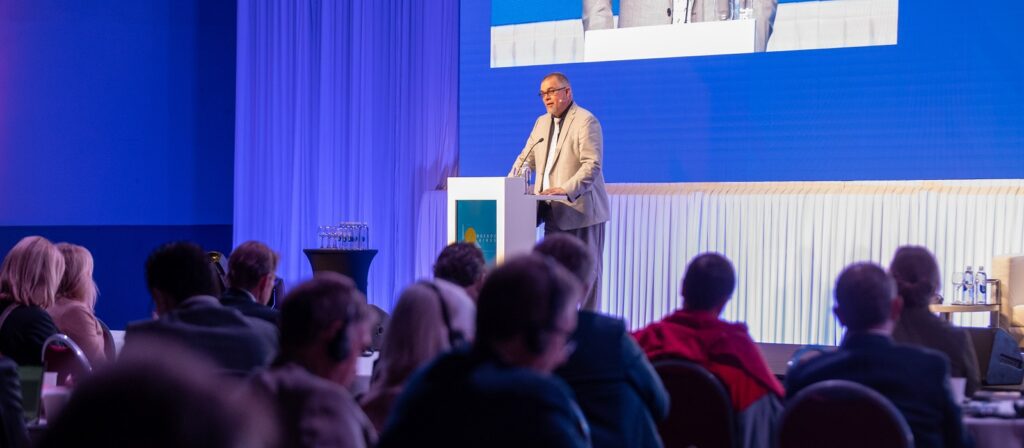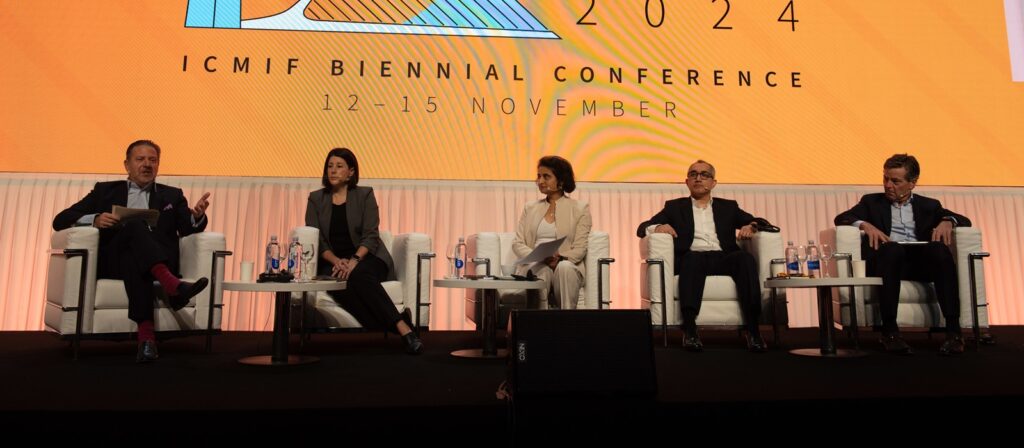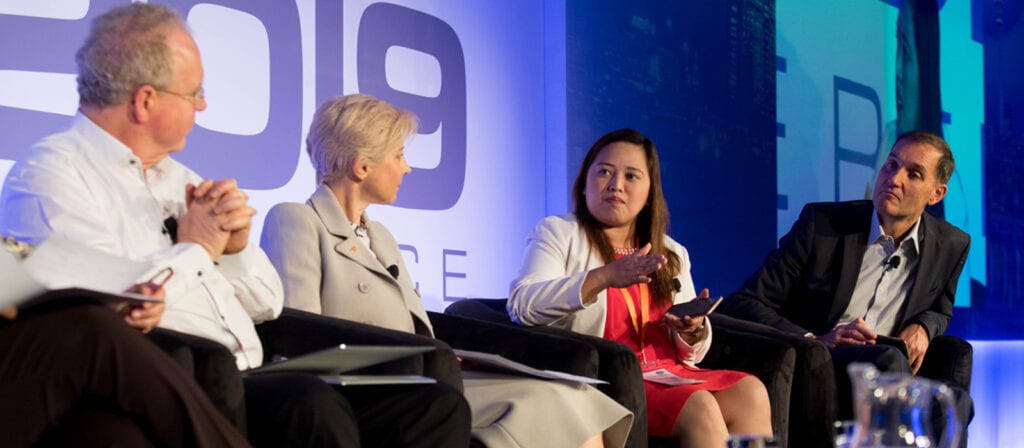
Click here to watch the full opening ceremony and welcoming remarks to the ICMIF Centenary Conference
The global landscape today is characterised by complexity, uncertainty, and a myriad of choices with far-reaching consequences. From visible geopolitical shifts to the hidden undercurrents shaping societies, understanding the present and preparing for the future is of critical importance. Democracy has consistently proven its connection to stronger and more resilient economies. While democratic systems face growing challenges worldwide, nations with robust democratic frameworks tend to enjoy greater stability and adaptability. A global assessment reveals that only a small proportion of the world’s population lives in “full democracies,” with many residing in “flawed democracies,” “hybrid regimes,” or “authoritarian regimes.” These distinctions influence global trade, defence budgets, and climate policies, underscoring how the outcomes of elections in one country ripple across borders to impact the broader international community.
Trade has long been a cornerstone of international peace and economic growth, yet the rise of protectionism is testing this narrative. The roots of today’s trade tensions can be traced back to the “golden era of globalisation,” when policies like admitting China to the World Trade Organisation aimed to promote openness and democracy. While China’s exports soared, many workers in the West saw their industries decline, sparking disillusionment with globalisation. This shift has led to a re-evaluation of trade policies, as leaders strive to balance international cooperation with national interests.
The rivalry between the United States and China dominates contemporary global affairs. These “two elephants” are engaged in a multifaceted contest spanning energy, trade, and defence. From NATO’s expansion to China’s partnerships with Iran and Russia, the world is witnessing a realignment of power structures and increased polarisation. Western nations distanced themselves from Russian oil and gas following the invasion of Ukraine, paving the way for China and India to step in as major buyers. This shift has altered global energy markets and highlighted the complex interplay of economic and political interests. Meanwhile, defence budgets in both the United States and China have surged, reflecting their strategic rivalry and its implications for international alliances.
Beneath the surface of visible geopolitical shifts, quieter yet significant changes are reshaping the world. Urbanisation continues apace, with the majority of the global population now residing in cities. Demographic trends, including declining fertility rates and ageing populations, present challenges for healthcare systems, labour markets, and economic productivity.
Technology is another transformative force, offering both remarkable opportunities and considerable risks. Advances in artificial intelligence and digitalisation promise to solve complex problems, yet they also introduce challenges such as disinformation, cyber threats, and the disruption of traditional employment. As these forces reshape economies and societies, careful navigation is required to balance their benefits and drawbacks.
Climate change represents one of humanity’s most urgent existential challenges. Despite this, it often fails to command the immediate attention it warrants. The impacts of global warming are already visible in ecosystems, economies, and public health, yet many nations struggle to prioritise long-term sustainability over short-term concerns. Addressing climate change requires a fundamental shift in perspective, recognising its urgency and integrating it into both policy and everyday decisions.
In this era of rapid change and interconnected risks, making informed choices is more important than ever. Decisions must balance immediate needs with long-term sustainability, taking into account the interplay between global trends and local realities. Collaboration, knowledge-sharing, and open dialogue are vital for navigating an increasingly “poly-risk” world.
The insurance industry is navigating an era of extraordinary global challenges and opportunities, marked by volatility, innovation, and transformation. Key themes shaping the sector include addressing a challenging global environment, closing the protection gap, fostering growth through innovation, and leveraging technology and talent for transformative change.
The past few years have been remarkable for the insurance industry, with record profits driven by strong capital market performance, elevated interest rates, and decreasing inflation. However, the backdrop of global volatility presents significant challenges. Political uncertainty, regulatory pressures, and escalating geopolitical tensions are creating a complex environment for insurers.
Increased regulatory scrutiny, particularly in regions like the EU, adds layers of complexity. Measures such as the Digital Operational Resilience Act (DORA) and the EU AI Act highlight the growing influence of regulatory frameworks. Simultaneously, trends such as deglobalisation and supply chain disruptions further complicate global operations. These factors limit diversification opportunities and increase costs, which in turn impact pricing and customer affordability.
A critical challenge for the industry is addressing the protection gap—the disparity between insured and uninsured risks. Rising risks, coupled with insurers’ reluctance to underwrite certain exposures, have widened this gap. While disciplined underwriting has bolstered profitability, it has also exacerbated accessibility issues for certain risks, necessitating a shift towards innovative and preventive solutions.
Innovation is indispensable for sustaining relevance and growth in the insurance sector. Insurers are increasingly tailoring products and leveraging digital technologies to meet evolving customer expectations. This is particularly crucial for engaging with younger generations, such as Millennials and Gen Z, who often lack traditional asset ownership and have limited understanding of insurance products. These cohorts demand simplified, digital-first solutions and are more inclined to trust influencers than conventional brands.
Technology and talent are the cornerstones of the insurance industry’s transformation. The shift towards a data-driven and digital-first operating model is imperative. Investments in artificial intelligence, IoT, and other technologies are enhancing operational efficiency and loss prevention strategies. However, legacy systems and data quality issues remain hurdles that need careful management.
Equally critical is attracting and retaining talent with expertise in technology and innovation. Despite its significant purpose-driven appeal, the mutual insurance industry struggles to attract younger workers. With a substantial portion of the workforce nearing retirement, mutual insurers must modernise their employee value propositions to appeal to the next generation. Mutual insurers, with their focus on purpose and sustainability, have a unique opportunity to stand out as employers of choice.
To thrive in this dynamic landscape, mutual insurers must adopt several key strategies:
- Leverage mutuality as a differentiator: The values and benefits of mutuality provide a strong foundation for building customer loyalty and trust.
- Modernise technology infrastructure: Robust and scalable digital systems are essential for innovation and operational resilience.
- Optimise cost management: Effective cost strategies ensure profitability while maintaining a purpose-led approach.
- Expand product offerings: Personalisation, digitalisation, and loss prevention should drive product development to meet evolving customer needs.
- Enhance talent acquisition strategies: A compelling employee value proposition is critical for attracting younger, tech-savvy professionals.
The mutual insurance industry stands at a crossroads, with immense challenges but equally significant opportunities. By embracing innovation, focusing on prevention, and fostering purpose-driven transformation, the mutual sector can not only navigate uncertainty but also build a resilient and sustainable future.
- Shaun Tarbuck, Chief Executive, ICMIF
- Alexandra Stråberg, Chief Economist, Länsförsäkringar (Sweden)
- Isabelle Santenac, Global Insurance Leader, EY (France)
- Rob Wesseling, Chair, ICMIF, and President and CEO, Co-operators (Canada)