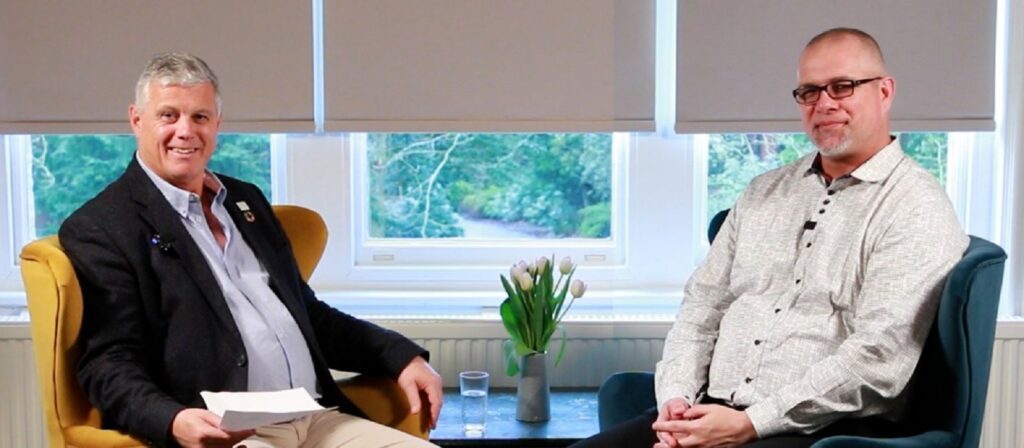
Shaun Tarbuck:
I’m going to turn to our real expert to Rob Wessling, and many of you know Rob who is CEO of the Co-operators, we said earlier and vice chair for the Americas for ICMIF. So Rob, over to you really. You’ve heard the new data from ICMIF members, what’s your first impression?
Rob Wesseling:
First off, Shaun, I think you may be overstating it by saying I’m the real expert on the panel or in the virtual room, but I am really pleased to have the opportunity to spend some time talking about this critically important subject today. Well, certainly the results are impressive. There’s no doubt about that. As you said the direction of travel is very positive and the velocity of travel is something that’s quite impressive as well.
We’ve been talking about exponential growth as it relates to the pandemic, unfortunately, and now we have an opportunity to talk about exponential growth in some areas like impact investing, resiliency investing, et cetera, and certainly the cooperative and mutual insurers are taking a leadership role here, which is not surprising, but it is certainly important.
Shaun Tarbuck:
So clearly the $576 billion invested in accordance with sustainable investment frameworks is definitely a headline grabber considering it exceeds what the industry committed to back in 2014, but why do you think it is the mutual sector that is doing so well in this area because, I mean it’s difficult to find out what the industry averages are, but we hear 2% or 3% is normal and we’re sitting at around about 37%? So it seems to be very high.
Rob Wesseling:
Yeah. Shaun, I think there’s a few reasons for that, but before I answer that question directly. I remember having a conversation with you just ahead of your address at the General Assembly and we were trepidatious about our ability to play a role in getting to the 400 billion, and here we are today having exceeded it just with cooperatives and mutual and we make up just below 30% of the market globally.
It indicates two things. I think it indicates leadership and it also indicates that the bar has been rising since 2014, more clearly needs to be done. So why are mutuals and cooperatives at the forefront of this? There’s two reasons that I’ll point to. One is that we’re purpose-built organizations. And so, we exist for a purpose other than simply maximizing profitability for the benefit of shareholders. And so, the social and environmental purposes that we exist for lead us to trying to play a role in solving longer term problems.
And certainly, that is something that comes through loud and clear at the end of biannual conferences. It comes through loud and clear in all of the webinars and educational opportunities that are available through ICMIF. And that leads me to the second reason why I believe that we’ve been able to push ahead in this space. And that is that we cooperate with each other.
I am consistently very pleased with the ability of cooperative and mutual insurers through ICMIF and on their own to actually help each other move ahead in these areas. And so, we were ahead of the game in 2014. We’re ahead of the game now, but there’s a… We have a catalytic impact on each other based on the fact that we share best practices, that we challenge and I think that’s a key reason why we’re ahead now and I hope it will be a key reason why we continue to lead in this area.
Shaun Tarbuck:
I mean you’re right. When we were back in 2014, it did seem like a big target and even as you know internally we set a target that we would like to get to 400 billion this year, which we have achieved. So where do you think we could be by 2025? Just to throw it out there.
Rob Wesseling:
It’s a big question. We are, as you know, Shaun, within ICMIF, we are in the process of developing the next strategic plan. And it will most certainly have targets and goals associated with 2025. So I’m not going to throw out an audacious number, but maybe some perhaps an audacious challenges for us collectively.
I believe that by 2025, well, even earlier than that, we should have moved beyond the types of goals that we have now with respect to sustainable investing. We should have targets that are related to Net-Zero as an example, perhaps targets that are related to transition finance and resiliency finance. We’ll need to work through that, but the point is they’ll be more sophisticated measures, because we have, our members have more sophisticated programs in place now that were in place when this current target was set.
When I look at the velocity that the report details, it strikes me that we should have audacious goals for 2025 and beyond. And in part, I think about if we cast back from 2040 or 2050 and looked at ourselves today and thought, “What role does the insurance industry need to play in moving to a Net-Zero carbon economy? And then, what role do mutuals, cooperatives need to play?” I think we would find ourselves with very aggressive goals.
I know within the Co-operators, well, we haven’t set this as a target yet, we’re asking questions like, “Why aren’t 100% of our invested assets in vehicles that are going to drive just the betterment of the communities that we serve and the global society on the whole?” So while I won’t say a number, because perhaps it would be too low if I did. I do think that we should be very ambitious on this front.
Shaun Tarbuck:
I think you’re right, Rob. I think the goals will change and we won’t measure it the same way. And it’ll be more about the Net-Zero commitments, but maybe we can drill down a little bit more into some of the investment side of things and look at the constituent parts for both you as the Co-operators and as the industry. So firstly, on the impact investing which collectively ICMIF members have nearly $11 billion, doubled from last year.
The Co-operators are global leaders in the impact investments with nearly 22% assets under management now and a commitment by 2030 to have 60%. So can you talk a little bit about why you’re so focused on this and what the challenges are you can foresee to get to that 60%?
Rob Wesseling:
Sure. Now, just for clarity. The 60% commitment includes impact investments, transition investments as well as something we’re calling resiliency finance, which I hope we have an opportunity to talk about perhaps later on. So let me start from the beginning. We made commitments to impact investment targets a number of years ago, and quite frankly we didn’t know if we would be able to hit them. We had to take a leap of faith to some extent, because the market, the impact investment market wasn’t mature in Canada or anywhere in the world I think at that point.
And so, part of what we were doing was trying to signal that a market needed to be created. So that leap of faith I think is important as we think about Net-Zero moving forward as well, but that’s another conversation. In terms of what our impact investments are, we have, as you said 22% externally verifiable impact investments. They are doing a number of things. They’re creating hospital beds and long-term care homes. They’re generating renewable energy. They’re creating mass transit, as well as impacting another, a number of social aspects as well.
What’s really critical for us in terms of impact investing is that this is not philanthropy. We have been able to invest this 22% of our invested assets in a way that generates market levels of return. So it’s comparable with other similar assets, and at worst, market levels of risk.
And so, it’s not just good for the communities that we serve, good for the planet. It’s actually good business for the Co-operators as well. And what I can share is that during the extreme level of volatility in the equity markets that we saw in 2020, these investments perform better than the rest of our portfolio. And so, I actually think there’s less risk in this portfolio than we have in our portfolio in general. And there’s a bit of magic in that. And I’m hopeful that, that experience will be a catalyst for others to really just improve the performance of their mutual, their cooperative, their business in general that by focusing on these areas of investment.
Shaun Tarbuck:
That’s great to hear as well. The fact that it outperforms the rest of the portfolio, it’s certainly a question we still seem to get asked, but anyway. Moving on to the green bond side of things. We’ve doubled in the amount invested collectively. And there’s now over a trillion dollars almost every year being issued in green bonds, if so, we’re still only a very small percentage overall from the insurance industry, but where do you think the advantages are for mutuals investing in green bonds, because you’ve got about 16% of your total assets in green bonds?
And do you think there’s any challenges to green bonds that maybe we could do better or maybe we could influence more as to how they’re more focused on actually delivering real change because that’s one of the challenges we hear?
Rob Wesseling:
There’s a few questions tied up in there. I’ll try and answer all of them.
I mean the green bond story for us is very similar to the impact story. We have in the Canadian space, we’ve been able to source, and in some cases actually be a catalyst for the creation of green bonds. And they, again, it’s not philanthropy, market rates of return, market levels of risk, they’re actually at higher demand than other similar securities.
And so, they performed extremely well. And then, they have the upshot of they’re actually improving the law for the communities that we serve across the country. And so, the calculus is really quite easy. Now, there are challenges for sure. We think a lot about the concept of additionality. And so, is a green bond that’s being created actually causing an action or an outcome that would have occurred anyway?
And that certainly is the case in some circumstances, but we do know, we do see that some of the bonds that are issued are driving changes that would not have occurred otherwise. And so, I think it’s the maturing of the marketplace that initially you label things that might have happened anyway, but you call them out because they’re having an impact that is positive. And then, that market builds after the fact.
I do wonder if there is just some inertia that needs to be created in terms of investing in green bonds, especially for cooperatives and mutuals. If it hadn’t been part of the program, part of the investment policy previously, be very comfortable to continue to invest in sovereign bonds and things like that. But I do think there’s a real opportunity for us to utilize the asset side of our balance sheet through green bonds to drive changes in our communities that align with the purposes of our organizations.
Shaun Tarbuck:
I think you’re right there, and maybe the last point we can pick up in the next question and you did allude to it earlier about investment in prevention and how we can maybe work through that. So I know you’re working very closely with the United Nations Disaster Risk Reduction team through the ICMIF partnership to see how mutuals can use their assets to invest in prevention and to make communities more resilient. Can you talk a little bit about this exciting initiative that has the potential to bring about real systemic change in how we fund and how we deliver impact infrastructure projects?
Rob Wesseling:
Yeah. I’d love to. I’m really excited about this project. And like the early days of impact investing, we don’t know how we’re going to do this yet, but we have a strong desire to. I’m thrilled with the partnership that we have with the UNDRR. They’ve really leaned into this. And they really recognize that the insurance industry can play a significant role in terms of realizing the Sendai Framework.
And I would also share that the Co-operators is a mid-sized firm in Canada, so small on the global scale. And it’s really been through our involvements with ICMIF that we’ve been able to get this partnership with the UNDRR off the ground. And so, it’s a really significant indication of value for us and our ICMIF membership. But, Shaun, I’ll stop doing the commercial for ICMIF now and I’ll talk about the initiative.
So essentially, at its core, what we want to do is we want to use the asset side of our balance sheet through our investments to de-risk the communities that we serve. And so, in Canada that could mean reducing flood risk in communities, it could mean reducing wildfire risk, etc. So here are some conditions that exist. There is a massive pent-up demand for the creation of resiliency infrastructure in Canada that like most places in the world, we are not well protected currently.
And when you think about the impacts of climate change over the coming decades, we are certainly not protected well enough moving into the future. There is also we believe a significant demand for investments that are along the lines of impact transition resilience. And so, we believe there are many organizations that would be interested in putting their money to work to increase safety, to increase the resiliency of the communities that they live in and they serve.
The challenge is that there is a great deal of complexity and getting those forces of supply and demand together into a vehicle that will actually drive change on the ground. Actually, get shovels in the ground and have these initiatives move forward. And so, that’s what we’re striving to do with the UNDRR and with a number of other partners that have quietly come on board to try and see how we can essentially get this new system of investment up and running in Canada, and hopefully, globally.
Shaun Tarbuck:
Yeah. I think you mentioned that the partnerships are quite crucial, aren’t they? When no one’s big enough to do this alone and no one has the connections to do it alone, but collectively we can. So a very valid point. Just moving to the Net-Zero commitments, and those of you who might have been listening just now to COP26, Antonio Guterres has just announced a task force for checking on Net-Zero commitments.
So a lot of people have signed the PRI and that’s kind of good. It’s moved the needle, but the next needle that needs moving is the Net-Zero commitments. And it’s good to hear that the UN is going to be checking on those. So you’re one of those that’s made that commitment, one of the few insurers around about 20 or so at the moment. Can you tell us what challenges you face that the corporation in setting up these commitments? And what challenges do you foresee in achieving the Net-Zero commitments you’ve made?
Rob Wesseling:
I believe for mutuals and cooperatives specifically these types of commitments are, they come with more challenge actually. And they come with more challenge because our members hold our feet to the fire to ensure that we’ve actually accomplished them. And that’s important. And that’s certainly, as we look at Net-Zero for our own operations as we look at Net-Zero for our invested assets, as addenda, our asset management firm as they look at it from an asset manager perspective, it’s all about taking a bit of a leap of faith to ensure that we can get there, because we can’t map out every step until 2015.
That’s a big challenge, however, as I shared earlier. We also can’t see a future where collectively the globe hits Net-Zero by 2050, unless organizations like ours step up and play an important role. And so, we have to. We don’t have an alternative is the way that we think of it. The interim goals I think are really important, because 2050 is a long time away, and I believe we will fail if we make a commitment for 2050, and then start worrying about it in 2045.
I think I’m really pleased to hear that the UN is going to be focused on measurement. And that interim goal setting and ensuring that we achieve those internal goals is very important.
Shaun Tarbuck:
Do you think given this is really new, do you think there’s a role that ICMIF can play to show leadership in this area, especially given that seven members have already made those commitments?
Rob Wesseling:
I do, Shaun. I absolutely do. And it’s for the reasons that we’ve talked about earlier today. We have a unique advantage in that our membership is willing to work together to share best practice, and challenge each other especially in areas like this where there’s such a strong common intent and a strong desire to reach a very similar outcome.
And so, I would encourage that we have to play a role in convening those tables. And I would encourage all of us as members to share our own best practices, to learn from each other. And I think that can be a real catalyst to drive us forward. The other element is that, it is powerful when ICMIF says, “We promised as an industry 400 billion in sustainable investments back in 2014, and now we’re coming up to the date and we’re close to $600 million just with ICMIF members.”
It shows the art of the possible to the entire economy and I think that’s a powerful role that ICMIF can play, has played in the past and should play in the future.
Shaun Tarbuck:
Thanks, Rob. Yeah. And then, as you said earlier about your members holding your feet to the fire, the governance of ICMIF will also do the same. If there’s a combined thought process to move in that direction, which we know there is. So just turning to the sustainable development goals and the reporting now. There’s clearly a momentum there for more mutual insurers to use the SDGs, to report their sustainability credentials.
And you’re an early advocate for this back in 2017. Can you talk a little bit about your SDG journey and how it’s changed the business?
Rob Wesseling:
Yeah. So in our last development, the development of our last strategy, we built a four-year strategy, but also set goals for ourselves for 2030 that were related to a subset of the SDGs. And so, we’ve endorsed and signed on for all 17, but there’s a set of nine that we’re specifically focused on, because they are areas that we believe we can impact. And so, that set of goals was integrated into the strategic development. And it’s also in many ways integrated into what we do every day now.
So the concept of inculcating sustainability, inculcating the SDGs is something that has moved quite far on here at the Co-operators. I’m really pleased that we’ve been able to work on the SDG calculator itself. And what that’s going to be, what that’s going to help us do is it’s going to help us really understand what impacts we’re having. And we’ll be able to communicate those impacts moving forward as well.
And that’s been a gap for us and I think a gap just across the system. It’s difficult to actually measure how much of an impact you’re having without the right taxonomy tools data in place.
Shaun Tarbuck:
I’m glad you mentioned the SDG Calculator, because that’s my next question. But there’s a webinar tomorrow that we’ll be going into that in a little bit, more detail so that’s good to know. We do have a question from the audience here, which I think is probably a good time for you to ask actually, Rob. Is the Co-operators doing anything to shift their clients or members attitudes towards living more sustainably and fighting the impact of climate change?
Rob Wesseling:
Yeah. So this has been one of the areas that we have struggled with to some extent. I mean we have, I would give us some credit for having product features, et cetera, that are in place that incent things like driving electric vehicles or hybrid vehicles. We have many incentives that are in place that are focused on reducing risk, so climate change adaptation.
We’re involved with a number of external partners that are focused on forest fire reduction, flood reduction resiliency in communities. The challenge that we’ve had is trying to find a way to incent or at least inform related to specific behaviors that individuals can play within their own lives. And so, that is an area that we continue to focus on.
The Mark Carney’s group that is the Net-Zero Insurance Alliance is a group that we’re investigating currently. We’ve not signed on as of yet, and the big question for us is what impact will we be able to make? And we’re thinking our way through that currently. That very question has been one that’s taken up a lot of head space for us. And it’s more challenging than the asset owner’s alliance, than the asset manager’s alliance or just becoming Net-Zero in our own operations.
Shaun Tarbuck:
Yeah. Just moving to your overall sustainability strategy, and I think this is where a lot of members and insurers generally are struggling to, sort of where does it sit, because it can sit on the asset side as you mentioned, you can sit on the underwriting side. It can sit on the corporate responsibility side, but I mean your journey started back in 2005, one could argue it started when you were founded in 1945. What would your advice be to those ICMIF members that want to start this journey?
Rob Wesseling:
I’m not sure if this saying is used outside of Canada, but there’s an old saying in Canada that says, “The best time to plant a tree is 20 years ago and the next best time is today.” And that would that be my advice. It’s never too late to start. Sustainability is not just good for communities, it’s not just good for members, it’s not just good for the planet, it’s good for business, and there are many examples of how sustainability has enhanced the business outcomes for ICMIF members and others.
And humbly, I believe that’s the case at the Co-operators as well. And if you haven’t started yet, you have the massive advantage. And that is that you have this network of organizations that have started, that have made mistakes, and corrected them along the way, and you have an organization called ICMIF that is there to bring those experiences to life. And so, you can actually move much more quickly than some of us did earlier on. And I think that gives you a much higher probability of success.
Shaun Tarbuck:
I think the key bit there you mentioned there Rob is about, this is a business opportunity, because not a lot of people are seeing it yet, but it is. You’re doing this purely because it’s good business and you’ve said that a couple of times just now. And now there is an awful lot of initiatives out there, every day it seems to be a new one springing up with a new acronym. How do you cut out the white noise and focus in those key areas to engage in outside of your organization? Would you have a recommendation for anyone that’s listening and that’s wanting to start that journey and where to put their time and energy?
Rob Wesseling:
It’s really challenging and membership organizations there are many views. And that’s actually that diversity of experiences and views and thoughts are a great strength for membership organizations, but it also means that there are many views on what the next best, most impactful thing for your mutual or cooperative to do would be. And that’s certainly the case here at the Co-operators as well.
I don’t have any advice on what an individual organization’s area of focus or targets should be. I think that is up to the membership and the leadership of that, of each individual organization. My advice would be, however, to identify some group of outcomes that you’re interested in, some success criteria. And we’ve touched on this earlier, Shaun.
In 2050, we would be successful if, and then what would have to happen? What would we have had to accomplish by 2025 or 2030 to make that happen? And if you can set those out as a North Star. Then, I think you have an opportunity to be successful and not to get distracted. And I’ll finish my response to that question with this, and hopefully, it’s not too bold.
One of the questions that we’ve taken to asking ourselves here at the Co-operators of late is there are so many opportunities for us to be involved in different initiatives is which one is having the most impact? Which one is doing the most good? And we’re less and less concerned with how it looks. So we’d rather do good than look good. And that helps cut through some of the noise as well.
Shaun Tarbuck:
That’s a good analogy, rather do good than look good, yes. Excellent. And just big picture now, obviously, COP26 has started in Glasgow and it’s clearly going to be a seminal moment for the planet. What’s your view on putting your ICMIF board hat on now, what role ICMIF and its members collectively can play currently and in the future? And what do you think our call to action could be?
Rob Wesseling:
Well, we are in an industry that is the risk managers for the world. And that is a critical important role, especially now when we see the impacts of not just climate change, but the impacts of many worrisome trends coming our way, but I’ll focus on climate change specifically. I believe our industry should be at the forefront in terms of understanding, modeling, communicating what the impacts of climate change will be.
Modeling, communicating how we can both adapt and mitigate, both of those items are really clear. And then, given that as a backdrop, what can ICMIF do? What should ICMIF do? As I said earlier, I believe strongly that mutual and cooperative organizations tend to be very forward thinking, because our purpose isn’t about next quarter or next year.
Now, we’re not the only organizations that have that future thinking view. I don’t want to leave that impression, but it is built into our DNA. And so, I think we can lead in terms of demonstrating how insurers can and should act, the work that can be done, the impact that can occur. And I’m hopeful that if we do that, that the industry will move in a similar direction, and hopefully, the entire economy will move in a similar direction.
And so, if I could sum it up in a statement, with ICMIF and ICMIF members need to lead on this front. And that would be my call to action.
Shaun Tarbuck:
Thank you, Rob. And I do think many of you are and the idea now is to get a consensus, a lot more of us that can do this, because it’s right for the business as you said and it’s right for the planet. So just lastly, the governments are hopefully going to come to an agreement in two weeks’ time on COP26. We don’t know, it feels as it’s a little bit like that.
There are a lot of movements from the business world, not just the insurance world, but the business world trying to force their feet close to the goals. What will be your message from us as the business sector to the governments in terms of how we should see this COP26 as being successful like COP21 was deemed to be on the road to success?
Rob Wesseling:
Well, Shaun, it’s very simple for me. And I think Boris Johnson might have said something along… Well, I know he said something along these lines, but I’m not going to get the quote right, so that I’m going to paraphrase, and hopefully, do it justice. Paris was about a promise and Glasgow is about delivering. And it is time to deliver. Every single day, every single year that we don’t move forward with substantive action, makes the action that will be required in the future more difficult to achieve.
So in my view, we have a choice. There will be a transition and we can either have an orderly transition, and that would mean bold action in Glasgow over these two weeks or we can have a disorderly transition. And I think we absolutely should all play a role in ensuring that the transition that we take to Net-Zero is orderly.
Shaun Tarbuck:
Thank you, Rob. That’s a great message to leave us with. And thank you very much for sharing your knowledge today. It’s been absolutely marvelous.
The above text has been produced by machine transcription from the video recording. ICMIF has made every effort to ensure that transcriptions are as accurate as possible, however, in some cases some text may be incomplete or inaccurate due to inaudible passages or transcription errors. Listening to or watching the video recording will allow you to hear the full text as delivered during the video but this is available in English only. Our transcriptions are provided to enable members to select the language of their choosing using the dropdown menu above.