Vicky Hughes:
Good afternoon, good morning or good evening to wherever you may be joining us today from around the world. So my name is Vicky Hughes, and I am vice president of membership at ICMIF, and I’m delighted to welcome you today to this virtual session hosted by the ICMIF Foundation. Now, just before we begin, I’d like to start by acknowledging and thanking the donors who have made the DHAN programme possible. Here on screen, you will see the logos of all of our contributing organisations. We’d like to say thank you so much for your continued commitment and for your belief in the power of mutuality.
Now, about the ICMIF Foundation. So at the ICMIF Foundation, our objective is to support mutual inclusion programmes to become sustainable, scalable and impactful. As mutuals, our strategy is a little different to others’, focusing on community empowerment and community engagement, which takes an initial investment of time and resources, but does bear fruit in the long-term once a strong community-based infrastructure is in place. The other unique aspect of the foundation is the impact we are able to make through the will and solidarity of mutuals helping one another. Whether it is the ICMIF member donors supporting our programmes or mutual microinsurers in the South providing technical assistance, together, over the last 10 years, we have been able to insure 3.6 million low-income households, protecting over 18 million lives. I’m sure that you will agree, this is a real testament to the power of mutuality.
Now, today, we are here to share the key achievements of the 5-5-5 Mutual Microinsurance Programme in India, a programme driven by DHAN Foundation, and made possible through the financing and technical partnership of ICMF members via the foundation. We are extremely pleased to have with us the leader of this work, who will take us through the journey. It is my great pleasure to introduce today’s presenter, Ahila Devi, chief executive of DHAN Foundation’s People Mutuals. For the last six years, Ahila has been leading the DHAN Foundation, scaling community-owned mutual insurance and risk-sharing mechanisms for low-income rural, informal sector and marginalised populations. Ahila will be very pleased to take questions following her presentation. You may either raise your hand or pop your question in the chat that’s provided. So thank you, Ahila, for being with us today. The floor is now yours.
Ahila Devi:
Thank you, Vicky, and thanks for the opportunity to share our journey. So I’m Ahila, CEO if People Mutuals. DHAN Foundation is one of the pioneer in India, and our overarching goal is poverty eradication, in which insurance plays here a major role. Next slide, please.
So regarding the Indian context related to risk, poverty and insurance in India. So 65% of Indian population depends on agriculture and informal livelihoods, and also, they are mostly vulnerable to health shocks, crop loss, livestock mortality and climate events. So in which only 20% of smallholder farmers and 15% of informal workers are covered by any form of insurance, because the insurance penetration in India was about only 3.7% of GDP. So the high-out of health expenditure is one of the major issue in Indian context that pushes families into debt. So in this context, the challenge of microinsurance is how the insurance could be accessible, affordable and community-driven. Next.
So when we see the risk and vulnerabilities of poor here, insurance plays here a key risk management tool. For example, poverty eradication can be happen through livelihood enhancement, as well as the safety net protection. Because the poor are having multiple perils, mainly the financial sags, that leds into poverty trap. So another thing is the limitations of savings and credit. Savings and credit can play a major role, and can able to serve the absolute need for affordable insurance, because the savings and credit has some limitations. Another one is for poor people in Indian context, the market and mainstream products are not offering appropriate and affordable product, so most of the poor were excluded from the formal insurance system. So here, the mutual insurance products place a major role, so mainly we inculcated the traditional risk management practises combined for risk mitigation. Another thing is the principles of mutuality expression, because of our social capital, that is possible. Another one of the major thing is the low insurance literacy and awareness. So these things are major drivers for initiating the microinsurance in our context. Next.
So if you see the DHAN Foundation, so here, our principle philosophy and approach is very quite unique. One of our philosophy is giving back to the society, so that starts from strategic tool to the field. So here, our approach is building people institutions, that is building social capital, and also mainstream collaboration, and third one is thematic intervention. Here, we are working in rural, tribal, coastal and with Indigenous people. So in each context, they are having different hazards risk, so in that case, so we have customised our products, savings, credit and insurance products.
And another one is our people institutions. So at each level, for example, in the village level, we are having women’s health groups, farmers groups, that are federated at the block level so that we can able to have the scale advantage. Another one is the uniqueness is our structure, that is circular structure. So in that, community is our focal point. So around that, we are building thematic institutions, specialised institutions, like People Mutuals for insurance, SUHAM for health, and we are having centres and we are having network. So the clear cut structure is one of the very unique way of DHAN to address the poverty. Next, please.
So if you see the DHAN Foundation overview at a glance, so we are working in 16 provinces in India with 130 districts and 1,000-plus blocks is the development unit. We are having primary groups is 82,000 groups. And so far, we have reached, through different programmes, like women empowerment, sustainable livelihood, farmer development, bank conservation, and the fishermen improvement, the coastal programme, through that, we have reached nearly two million poor families across India. So here, the members are having different multiple benefits, because poverty is a very complex phenomena, so we are having healthcare services, insurance services, and the farmer producer organisation for getting better price. So overall, our vision is to build poverty-free resilient society through community institutions and innovation, with the philosophy of giving back to the society. Next, please.
So if you see the profile of our policyholder, we are working with only poor and pro-poor in India, because those people are excluded in many areas. So our policyholders are especially small and marginal farmer, women micro entrepreneur, fishermen, and small service sector working in service sector areas, in especially rural and semi-rural areas. So they are part of our community institutions, called self-help groups, our farmers’ federations, our fishermen groups. And here, in our clientele, nearly 80% are women, because the poor women plays here a major risk, and also, our policyholder aged between, on an average, 30 to 54 years, with limited formal educations. And the other thing is they face frequent health hazards, livelihood hazards and life risk, because they have minimal access to formal insurance. And another beautiful thing is even within poor, we classify the poor into that is poor, very poor, poor and somewhat better. We call this Survival, Subsistence and Self-Employed. Next.
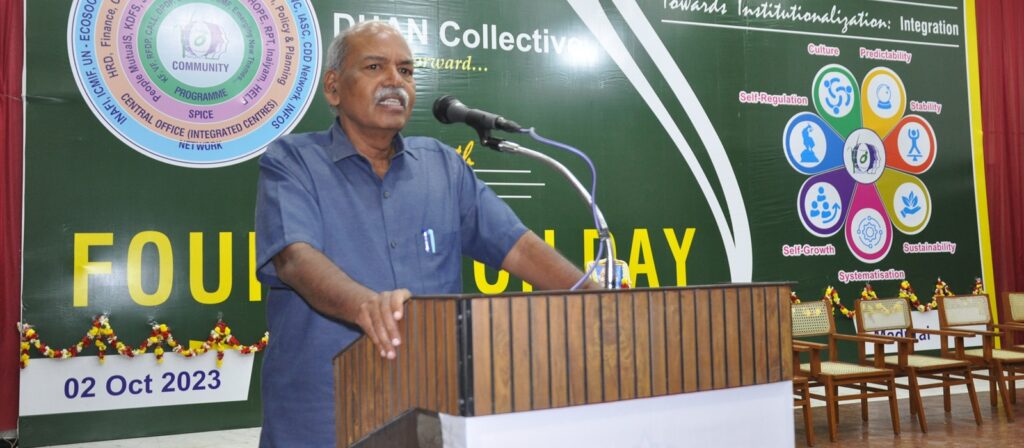
Another one of the unique things we have done is every October 2nd is Foundation Day. So in that, the people declared self-declaration by the poor people, they are coming out of poverty. So we know very well that the entire nation is working, globally, we are working to achieve the SDG Goal 1, end poverty in all its forms everywhere. So if you see that in the last October 2nd, nearly 42,000 member families have self-declared they’re out of poverty. So for us now, out of 20 million poor families, nearly 0.6 million people come out of poverty through various intervention, livelihood enhancement, risk management, healthcare advancement, so there is a combination of multiple benefits the people declared out of poverty. And also, we have tracking the poverty mobility, from one stage to another stage. For example, how many people moved from Survival to Subsistence, Subsistence to Self-employed, and Self-Employed to move out of poverty. So in that way, I am sharing that because the risk management plays a vital role in poverty eradications. So in that, the insurance/microinsurance plays a major role in poverty eradication. Next.
So People Mutual is the insurance arm of DHAN Foundation. This is community-owned mutual risk management institution. Because why? Because possible is that because the member-owned institutions, that is our social capital, built by and for the people, the community-owned, community-managed institutions. So here, another thing is the governance by the community. So the people lead us, which is democratic, transparent and accountable for each and every activities, they are involved in end-to-end processes. Another one is because of our scale advantage, the risk pooling is possible in our system so that we have initiated different mutual insurance for livelihood, life, health, crop and asset production.
And another USP of Dhan is each and every activity and intervention, our major focus is sustainability and inclusion focus. So all our microinsurance activities are very low cost, need-based and equitable access. And another thing is, at the same time, we have insured the actuarial tools and the risk rating, with the help of the insurance companies and the reinsurance companies, and we took the advisories from the imminent people in the insurance sector, we customised our insurance practise products to suit the need of the people. And also, we partnership with various insurance at national level and international level. Another thing is one of the major thing for microinsurance is the capacity building and education. We call this here continuous insurance literacy to achieve the sustainable payroll change communication. That is one of the core of People Mutual. So People Mutual is by the people, for the people, and building resilience through mutuality is our motto. Next.
So if you see that mission, it starts with addressing the hazard of the poor people, because hazard is very easy to address in the earlier stage, then hazard to risk and vulnerabilities. We are having three different approach, collaboration with mainstream, and we are having mutual solutions, and third approach is we are having both hybrid solutions, hybrid with the mutual as well as with customised product with mainstream access. So these three different approaches helps to eradicate poverty through comprehensive risk management system. Next.
So if you see the social security programmes in DHAN, we are having life insurance, because the risks faced by our members are livelihood risk, life risk, in case of death, disability and longevity. In health, they need primary care, secondary care services, tertiary care services, because health is one of the major risk, because of their livelihood pattern, their living condition, their nutritional pattern. And the third one is the livestock, because we are working with mostly small and marginal farmers, the livestock is the lifeline for most of the people, so death of animals is one of the risk, and also becoming unproductive is also one of the risks. Another thing is they are having the risk of crop loss and price risk.
Recently, we are addressing credit risk and livelihood risk also. Also, we are having pension products. So if you see the products we are having, working with collaboration with the government, as well as the corporate agency for life insurance and mutual, that is supported by ICMIF Foundation, we started mutual insurance, Life Mutual. And health also, we have collaborated with both the government, as well as corporate. And also, at the same time, we are having mutual health programme. In livestock, also we are having collaboration and mutual programme. Because while the mutual is very unique in the cases, we found a lot of gaps in government, as well as the corporate agencies programme, so to address those gaps, we initiated our mutual insurance programme. Next, please.
So if you look into our dashboard, as of March ’25, we distributed nearly 29 million policies across India for the 20 million core households. Because the multiple policies is very much important to build the resilience of the community. Otherwise, if you give one or two products, that is for $10 or $100, that will not really address those issues and risks. So in our experience, we found that multiple policies with multiple products, then only we will be able to move towards the resilience of the community. So the comparative production for the poor with life, health, crop and livestock together is very much important. So if you see the premium, nearly $73.71 million USD in the last year, with a sum assured of this much of amount. So we are working with ICMIF for the life and health. That is instrumental to initiate the next level of crop and livestock, with the support of InsuResilience fund. For the government and the corporate agencies, we are working closely with the major companies in India. Next.
So here, DHAN’s strategy towards sustainable mutual insurance is one of the core. We are the pioneer in mutual insurance in India because the need-based solutions evolve through community organisation. As I rightly said, for example, one of the gap in life insurance in India is they have not covered the entire life period of cover, up to 58 age only they have covered. But poor people need more security when they become more age, so we initiated our own product that covers the entire life of the poor people. Another thing is they need some kind of expenditure for their funeral expenses. So the mutual insurance can be able to sell this kind of leftover things in the market products.
Another one is the health assistance. For example, the Health Mutual, immediately they provide the incidental cover, the incidental cost. And also, the virtual wellness centre during COVID plays here a major role, because the prevention activities are very much important. And the yearly diagnosis and outreach camps also, we will be able to provide insurance plus activities. That is possible only because of this, our own community insurance. In crop also, not only we are providing crop insurance, that non-financial risk management along with the insurance plays a major role. Another thing is the microinsurance, one of the crucial factor is the affordable premium and very simple processes. Through their self-help group itself, they can able to enrol, they can able to easily renewal, they can able to get the client, because the cumbersome process makes the poor ahead of the insurance in the market system, so we fulfil these kind of gaps in our virtual.
And not only the simple process, and third one is the financial soundness by way of transferring the risk through backup insurance and reinsurance systems with insurance companies, and also with reinsurance arrangement that also we insure. For example, in crop and livestock, we are working with IFFCO TOKIO for reinsurance. Another thing is the residual surplus retained at federation that helpful to conduct risk prevention measures, because that is directly related with, for example, if yearly diagnosis means that it decreases the mortality rate, so the risk prevention measure, also one of the very crucial thing in mutual insurance, that is possible because of the residual surplus.
So now, for the poor, the credibility and trust on mutual insurance is one of the beautiful thing so that we will be able to continue this product with community involvement for the longer period. And in that, I already told that continuous insurance literacy and training to our leaders, members and staff, is the crucial thing. And we established call centres and risk resilience centres for connecting with the last mile. So we are having the mutual programme for Life Mutual, Health Mutual, Livestock Mutual and Crop Mutual. So mutual insurance, because resilience is built, not bought, that is the proven thing in our system. Next.
So we are very much thankful to ICMIF Foundation. The ICMIF Foundation, under 5-5-5 Project, we have started our journey with ICMIF in 2019. So continuously, that is the very trigger point to initiate our mutual insurance. If we see our growth path from year one, this is our year eight, because we are continuously doing that. We started with nearly that is 20,000 only, but now we reach nearly 1.2 million core people during this year. Also, we are working in nearly 14 states in India to cover the people under mutual insurance, both Life, as well as the Health Mutual. Next.
So the uniqueness of mutual. For example, if you see that we reached nearly 1.2 million people under mutual policies, so in that, mostly the female is nearly 75%. Another thing is the more than 58 age covered, who are all the people they are excluded from the formal insurance system, is nearly 0.2 million people. In that, female is nearly 0.1 million people. So if you see the claim amount, so the claim also increased, and that shows the credibility and the trust of our people. So if you see the claim ratio, 80% is claim ratio in life and 75% in health. As I already explained, we are providing funeral expenses support every year, and we conducted health camps. Every year, we conducted minimum of only 88, that is an average of 200 camps per year, around 10,000 members were benefited for yearly diagnosis. And if you see that the risk reserve after serving the claims, nearly we are having this much of risk reserve under both Federation Mutual and People Mutual, that shows the sustainability of this programme. Next, please.
So ICMIF Phase II, we are thankful to ICMIF, with the bike ride, they have mobilised some fund, thanks to Steve and Liam. So that fund, we have utilised for that Phase II. We started with July 2025 to cover nearly 50,000 lives under life and health. So within this two and a half months, we will be able to reach nearly 15,000 lives, under both life as well as health. So if you see that our continuous growth, for example, in the 5-5-5 project, we reached nearly one million people. After that also, during ’23, ’25, even without any financial support from ICMIF, we will be able to reach 0.2 million. And during this phase, nearly we have reached nearly 11,452 people.
So in that, we will be able to see that, and because this kind of initiative is sustainable when properly the concepts are seeded and the community taken as their own product. So even if you took that during this period, nearly 2,558 members have been reached in different training programmes for staff, as well as leader. So in that, although also more than 80% are women. So if you see the fund support, the USD is $27,000 in the earlier 5-5-5 project also, so less than $1 support to cover the one life. So if you see that to protect one precious life, less than a dollar support, it has multiplier effect. So it’s the very uniqueness of the ICMIF support in that. Next.
So after that, the major transformation and progress is because of after that ICMIF support. For example, first , we started with the basic coverage, because the poor people, we have to address their basic risk. So they are having life and health is we addressed first, then we moved into advanced livelihood coverage of crop plus livestock. Now, to build the resilience, now we move into endowment product, that is savings plus insurance. So this kind of expansion of social security coverage across multiple states and multiple policies is our major transformation during the last three to five years. Another thing is now we move into integration of climate risk insurance with risk resilience centre. With the last two years, with the support of ISF, now we are addressing the climate risk also. And the third one is the capacity building, that is also continuously we are practising . And fourth one is the digitization of claims and processing to improve our efficiency of the system, we started. So here, the protection is not a privilege, it’s a pathway to resilience through our major transformation. Next.
So here, the major key insurance penetration activities are we are having centre for financial literacy, mainly for financial inclusion for the poor people. Based on that concept, we have initiated Insurance Literacy Awareness Programmes, mainly that aims for sustainable behavioural change communication. Because the poor people, the continuous education arm the insurance or any other thing, so one, it will be continued until it reaches the behavioural change, so we are having continuous training on that. And we initiated the Climate Risk Resilience Centre, nearly 120 centre we initiated. Here, we educated our farmers on risk prevention, risk adaptation and risk mitigation activities. Another thing is, as I already explained, the multiple policies for a family, for example, minimum five to 10 policies. So this poster clearly explain about life insurance is our duty, health insurance is our need, crop insurance is essential, livestock is mandatory and pension is safety. Next.
So the Risk Resilience Centre, they are comprehensive approach for risk management with the climate risk adaptation, the farmers enrolling in crop and livestock insurance, conducting risk prevention as a risk prevention. We are conducting awareness programmes to educate farmers on risk mitigation, and we are facilitating the functional agriculture risk management through majorly agro-advisory and livestock advisory on organising farm field schools and veterinary camps, and mainly the knowledge-sharing among the progressive farmers. So here, peer-to-peer education, peer-to-peer sharing, is the very key things for building resilience. Next.
So here, the key factors in insurance penetration, one is our strong social capital with mutuality, that was expressed in our basic groups itself. And the second one is the people leadership and governance and their contribution. And the People Mutual is a guiding and enabling institution, mainly for co-insurance and reinsurance arrangements and capacity building materials. Here, the Federation Mutual, we created the specialised institutions for advancing and deepening microinsurance activities with long-term sustainability. So far, we have created nearly 173 Federation Mutual. Their main purpose is to social security with very focused activities. So here, our Mutual Federation act as a key distribution point for mainly enrollment, and here, the claim settlement is by growing trust through prompt claim settlement. Another one is, because of our thematic institution, mother institution, we are leveraging services from savings and credit for insurance and renewal systems and processes. So the protected communities here, progressive community, that’s possible because of these kind of strategies. Next.
So here, in ICMIF and DHAN, the major impact when we are working together, one is ICMIF allows the retain the mutuality with flexibility. So that fund is a very trigger point to initiate and scale up the mutual call centre. And we started the holistic approach and comprehensive risk management, mainly on awareness raising, insurance literacy, risk prevention activities. And also, we learned many things, one is the technical knowhow, how we communicate with the technical support from Achmea Re, it was very much helpful to us. And also, we built and co-created the national level and international credibility on DHAN as a pioneer in mutual insurance. We are the one in India, we reached the one million core in the 5-5-5 project.
And also, it motivated our staffs and leaders by knowing the successful and like-minded mutual institutions. And when we invited and shared the experience during the visit of our AOA technical committee and ICMIF Foundation members so the people know very well and we focusing on prevention from protection through the many intervention. Another thing is now, DHAN growth as a technical assistance provider, now we strengthen our role in South-to-South collaboration, providing practical and field-tested guidance on strategic and auditing, like our UNDP ICMIF IIC project with SANASA Life Insurance. So that co-creation and co-learning, a lot of things happened because of our ICMIF and DHAN collaboration. Next.
So not only in insurance, because our business is not only buying and selling insurance, but we are focusing on poverty eradication. So in that poverty eradication, how the risk management is comprehensive risk management, so the non-financial risk areas are very much important. So because of our collective strength and scale, our people can be able to practise the mutuality in an organic way, so the awareness creation and transparent system and processes. And we are integrating the traditional practises into our own activities, the advisory services. Another thing is the scale-up and move ahead from one level to another level, from local to regional level and regional to zonal level, that was possible, that was happened because of these kind of initiatives. So many times, we have seen only the numbers, but apart from that, multiple leverages are possible because of this kind of donor support. Next.
So definitely, we are impacting on SDGs. The contribution to SDGs is we are directly impacting our no poverty, good health, gender equality and economic growth, as well as the climate action. So all our products are directly related with reduced vulnerability, affordable and accessibility to healthcare. Women-led federation, our gender focus, 80% of our clients are women. And the protection of productive assets and livelihoods is through our crop and livestock. And definitely, our climate-smart agriculture products impact on climate action. And also, another thing is we are thankful to ICMIF, with the help of Swiss Re, we calibrated SDG calculator for impacting insurance in 2014. Next.
So the way forward is capitalising the opportunities and addressing the challenges. So insurance literacy is the need of the hour. Now, we move into weather parametrics and heat index, and also the continuous education on Life Mutual and Health Mutual for the underserved community, and product innovation to contextualise and customise product suitable for different ecosystem, and data and technology advancement. And to theorise our practises into knowledge product, we are having our own centre, so micro studies, research and documentation, we are inviting a lot of interns to document our case studies. And also exploring our new global partnership and collaboration through our DHAN International, and we are ready to exchange programme across the country for cross-learning on microinsurance. And we are continuously conducting one training programme on advanced reflective training on microinsurance, and our technical advisory role for other people, and the Immersion Programme. These are some of the possibilities to working together with other institutions, so it shows that clearly, every insured life is a step closer to freedom from poverty.
TRANSLATION SUBTITLES:
I am Devi, member of Naga Mariyamman Kalanjiam. There are 20 members in the Kalanjiam. My mother is one among them. Four months back, she was expired due to health issues. During that time, it was COVID lockdown. Kalanjiam member helped me a lot during that time. Spouses of Kalanjiam members are also helped. My mother paid Rs.100 for People Mutuals insurance premium. So we have received the claim of Rs.10000. We got the claim amount within a month.
My mother don’t have a son, so I did everything for her by taking outside debt. With the claim amount, I have repaid outside debt of Rs.5000 and started a petty shop with the rest amount of Rs.5000. There is no insurance scheme for age more than 60 years like my mother. But this mutual insurance scheme with Rs.100 premium is very much helpful for us.
TRANSLATION SUBTITLES:
One year before, I have undergone uterus surgery and spent around Rs.45000. I have got enrolled in yearly medical insurance programme through Kalanjiam. We need to pay Rs.450 as premium for a five-member family. Earlier, I don’t know about health insurance. I used to ask people, “Why do you enrol in health insurance?” Later, I have seen many people getting claim and get benefit out of this. Madam (Federation Coordinator) also explained its benefits.
One year before, I have undergone uterus surgery in a private hospital and spent Rs.45000. I have submitted all the necessary bills to Madam, and she has supported me to claim the amount of Rs.7000. In our group, six members have got claim for different disease. Each one claims different amount ranges, from Rs.2000 to Rs.10000. We used to meet the unexpected health expenses through outside debit. This claim helps us settle the outside debts.
TRANSLATION SUBTITLES:
I am Lingammal. I am a Kalanjiam (Self-Help group) member since 20 years. My Kalanjiam is Velvengalam Kalanjiam in Jaihindpuram Federation. No insurance agencies will cover after a particular age. But in Mutual Insurance Programme, there is no age limit. It is possible to get insurance for any age. This mutual coverage and amount will be very helpful for old-aged people. Hence, we are enrolling in the mutual insurance.
Death is common for all. Even now, I am not getting benefited for the premium paid. However, 100 members’ premium is helping one poor member in our Kalanjiam across nation. This gives satisfaction for us. We used to pray for no loss in our families, but it may happen at any time. On those occasions, this mutual insurance will give benefit, so we are enrolling in mutual insurance.
Even if I paid the premium for 10 years, approximately it may be Rs.2000. However, we could claim an amount of Rs.20000. It is not a small amount. On the death day itself, the member’s family will get the funeral expenses as part of the sum assured. Suppose something happened to me, during that occasion, my family don’t worry about funeral expenses. My Kalanjiam family will give the amount to my family. This system is oriented to all members.
Since our members are daily labourers, they no need to pay the premium from their earnings. It is also possible to pay from their annual interest amount on savings. Hence, the mutual insurance is very much useful for poor. Since our Kalanjiam is working across 14 states, though the premium paid by me is a drop in the ocean, it will support for a loss for a poor family, which gives me heartful satisfaction. We are taking efforts to sensitise the system among our members.
Vicky Hughes:
Well, thank you so much, Ahila and the DHAN Foundation team. I’d really like to congratulate you, because clearly, the growth that you have achieved is having an impact on so many lives. So thank you again for your insightful presentation and for sharing the life-changing work and protecting the poor and vulnerable working to eradicate poverty the DHAN way. So we will now open the floor for questions. If you haven’t done already, please do feel free to type your question into the chat or raise your hand.
So sometimes it takes a few minutes for everyone to gather their thoughts after watching a presentation, so I thought I would kick off, Ahila, with a question for you. In terms of the mutual program’s progress, where do you think it would be today without the financial support of ICMIF members?
Ahila Devi:
Yeah, it’s a very good question. For example, as I already said, that ICMIF support, it plays a major role and it was very much helpful, it act as a trigger point for initiate and expand our mutual insurance programme. So without the ICMIF support, means our mutual programme could have taken much longer to reach today’s scale and stability, because the yearly funding and guidance from ICMIF members gave us the confidence to pilot innovation, customise the product and build systems, and it definitely helpful to earn community trust on mutual insurance. And also, this partnership helped us move from an idea to an institution. So it’s creating a strong base of governance, digital system, that call centre concept that we will be able to scale up very much, and it builds the community ownership through this project. And today, we can say that the mutual programme has matured into a self-sustaining model thanks to ICMIF Foundation for the yearly investment during that project.
Vicky Hughes:
Thank you, Ahila. I thought I would just share a message of support that we’ve had in the chat from Caroline Surin, who says, “Wow, what incredible stories. This demonstrates the success of this programme. The assistance provided to people during the most challenging times is truly remarkable. Thank you for sharing everyone’s stories. I speak Tamil, so I clearly appreciate the importance of this help and the significant differences ICMIF has made.” So that’s a really lovely message of support there, yes. Thank you, Caroline, for those words. So do we have questions from anybody? Anybody who would like to ask a question to Ahila?
Okay, so I’ve got another one to ask you. So in terms of maybe some advice here, some mutuals in emerging markets struggle to launch and scale crop insurance and parametric insurance, so in DHAN Foundation’s experience, what have been the key learnings and challenges in developing and implementing these products, and how important was it to have the basic mutual insurance products and infrastructure in place to facilitate introducing the crop insurance programme to achieve the scale that you have?
Ahila Devi:
Yeah, yeah, it’s a very needed question, because even though in India, the developing crop and parametric insurance has been a learning journey for us, because the main challenges were the lack of reliable data and farmers’ limited understanding, not only farmers, even our own staff’s limited understanding of these products. So another thing is like ICMIF, we received support from ISF for innovation and scaling up, so that’s a very good thing, we are honoured. Another thing is because we already had basic mutual products and strong community institutions, so as that basic, we could be able to build on the trust to introduce crop insurance. For example, one member who is enrolled under life and health, then they can be able to listen to move on the livelihood protection of crop insurance.
Another thing is the key lessons are we started with very simple product and we co-designed with farmers, involving the people from end-to-end, from designing the product, understanding the product, ground truth verification of the satellite data and claim settlement, everything, we involved the farmers from end-to-end. Another thing is we strategized with traditional practises. We are listening the farmers, whether the triggers are correct, what is the historical trends, historical payouts, so everything we have inculcated with the traditional practises. Another thing is the continuous training to our staff, as well as leaders. So these are all the key lessons. Now, we can be able to reach nearly, last year, 25,000 farmers with the weather parametric insurance. And this year also, we get the support from ISF Phase II, and we are going to reach another 25,000 farmers under weather parametric insurance.
Vicky Hughes:
Thank you.
Ahila Devi:
Yeah. Another one thing is these products work best when backed by solid mutual infrastructure and community ownership, that is the key lessons we’re learning. And we started with pilot before scaling, then only we can be able to reach more farmers during these years. Thank you.
Vicky Hughes:
Thank you. Yes, I think that’s really great advice, isn’t it, to start off in a simple way, scale up, and to really know the needs of your members. So do we have questions from anybody? I think not. I think you’ve answered everybody’s questions today, Ahila. So thank you so much to everybody who joined us today. Thank you again to you, Ahila. If you would like to learn more about the ICMIF Foundation, you can reach us by email or visit our website, LinkedIn page or YouTube channel, where you’ll find the stories, reports and updates from our programme around the world. We really do appreciate your time and engagement and your ongoing support of mutual solutions for inclusive insurance. So thank you so much to everybody who has joined today, and wishing you a wonderful rest of your day.