Disaster risk reduction (DRR) is rapidly emerging as a strategic frontier for institutional investors, insurers, and asset managers seeking both financial returns and measurable societal impact. Organisations such as L&G Asset Management (UK), ImpactA (UK), Co-operators (Canada), and the United Nations Office for Disaster Risk Reduction (UNDRR) are at the forefront of this movement, demonstrating how innovative financial mechanisms and blended capital structures can transform resilience from a policy aspiration into a credible asset class.
Mutual and cooperative insurers are increasingly leveraging advanced investment strategies to strengthen resilience and support sustainability objectives. By aligning capital with high-impact outcomes, such as investments in disaster risk reduction infrastructure and services, these organisations are addressing climate-related risks while advancing long-term strategic goals. The integration of data technology, including artificial intelligence and remote sensing, now enables the quantification of risk and the benefits of mitigation in ways that are transparent and credible for investors.
A key challenge has been the lack of open standards and standardised metrics for risk intelligence, which are essential for investors and insurers to understand and compare opportunities. However, progress in risk modelling and the development of resilience-linked financial products are helping to overcome these barriers.
Blended Finance: Aligning Public and Private Capital
Blended finance structures are central to unlocking investment at scale. By aligning incentives between public and private capital, these structures enable risk to be shifted to the most appropriate holders. For example, public funds may absorb the riskiest tranche of losses, thereby enabling commercial and institutional investors to participate with greater confidence. This approach not only scales up available capital but also creates diversified portfolios that generate what is termed “resilience alpha”, stable investment returns derived from measurable risk reduction.
Insurance solutions, including parametric insurance and insurance-linked securities, play a pivotal role in covering tail risks, while private credit and equity investments support mitigation projects and technology innovation. The result is a robust ecosystem where resilience becomes an investable asset class, attracting long-term capital and delivering both financial and social returns.
Case Studies: Wildfire and Flood Resilience
Recent initiatives have focused on wildfire resilience in data-rich environments such as California. Here, capital is strategically deployed into mitigation projects, such as home hardening, defensible space creation, and early warning systems, supported by private credit and insurance solutions. These interventions can reduce expected losses from wildfire by 40 to 60 percent for retrofitted homes, demonstrating the tangible value of resilience financing.
Similarly, flood risk reduction is being addressed through nature-based solutions and infrastructure investments. By increasing access to flood insurance and financing mitigation systems, these projects generate new revenue streams for insurers and investors, while shifting risk away from the public sector.
Co-operators has integrated resilience into core business strategy. The organisation has pioneered comprehensive flood insurance, resilience-enhanced products, and the Resilience Acceleration Lab, which seeks to create a new asset class for resilience infrastructure. By investing in climate-adapted infrastructure and supporting clients to rebuild with resilience after losses, Co-operators is addressing both the protection gap and the affordability crisis exacerbated by climate change.
Scaling Resilience in Emerging Markets
ImpactA and L&G Asset Management are collaborating to deploy private credit into sustainable infrastructure across emerging markets. Their approach combines debt financing, outcome-based bonds, and blended finance structures, often in partnership with development finance institutions and government guarantees. By taking on uncovered risk tranches and aggregating capital, these organisations unlock large-scale transactions that support adaptation, resilience, and social impact, particularly for vulnerable populations.
A recurring theme is the need to monetise the avoidance of losses and to provide investors with clear, measurable outcomes. The development of standardised metrics, rigorous risk modelling, and transparent reporting frameworks
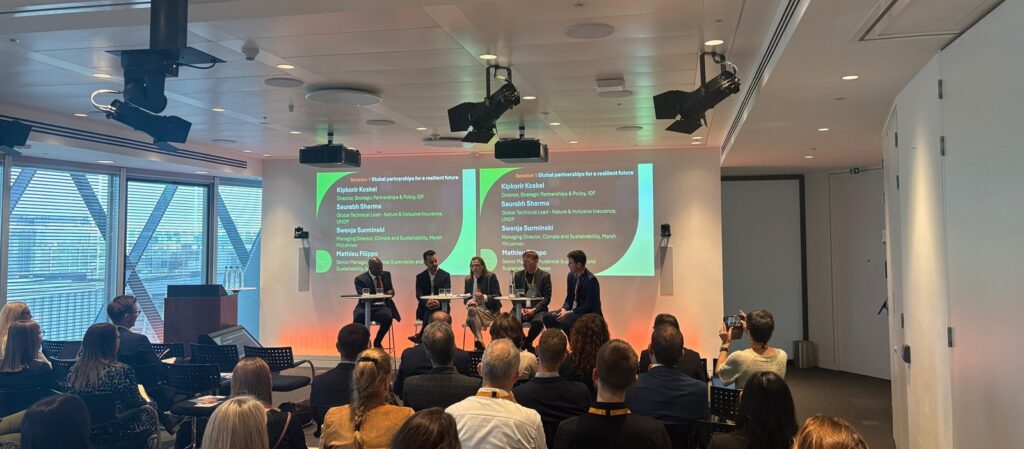
Speakers:
- Jake Harper, Senior Investment Manager, L&G Asset Management (United Kingdom)
- Victoria Miles, Co-CEO and Co- Founder, ImpactA (United Kingdom)
- Shawna Peddle, AVP Sustainability, Co-operators (Canada)
- Alissa Legenza, Board Member, UNDRR Investment Advisory Board – IAB (USA)